E-Way Bill Distance Rules: PIN-to-PIN, 10% Margin and 50 km Part B Exemption
How distance works in an e-way bill: the portal's PIN-to-PIN auto-calculation, the 10% margin, the 4,000 km cap, same-PIN movements, the 50 km Part B exemption, and how distance drives validity.
Last verified against official sources: 11 Oct 2026
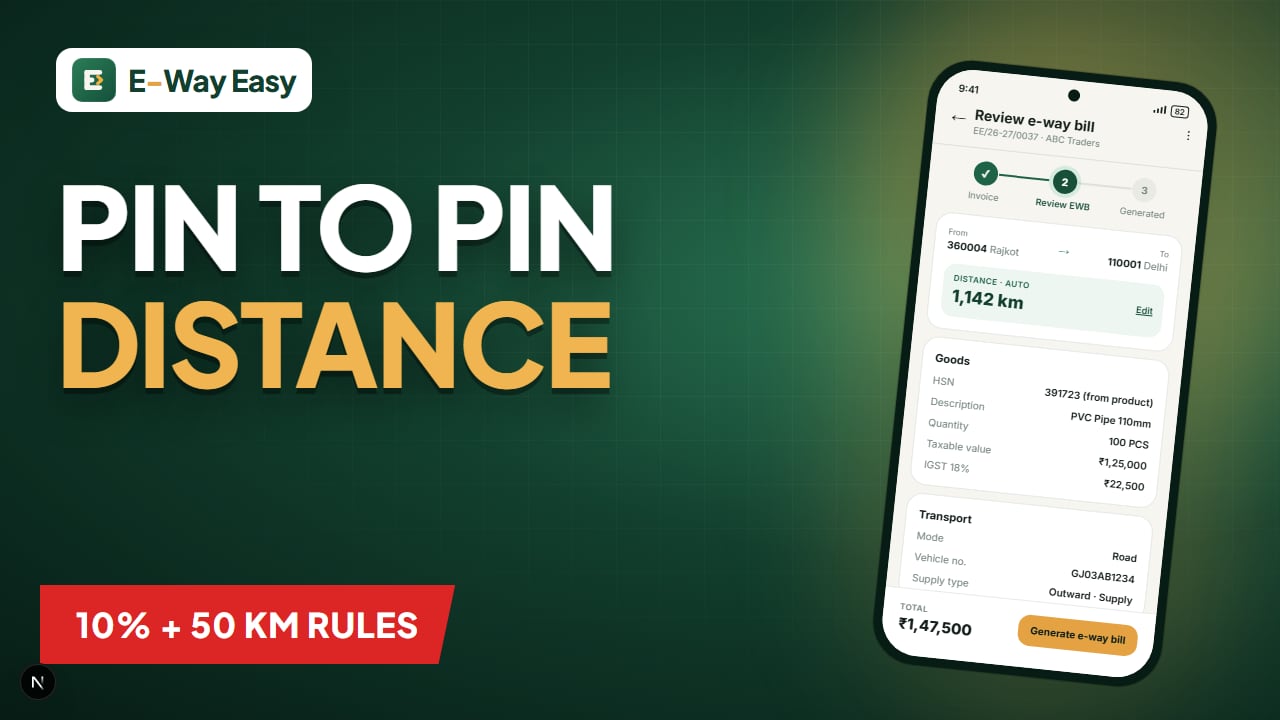
Table of contents
- How the portal calculates distance
- Example (illustrative): the 10% margin
- Example (illustrative): when the margin matters
- Distance and validity
- The 50 km Part B exemption
- What it does not mean
- Example (illustrative): last-mile and first-mile legs
- Movements across state borders over short distances
- Distance in special movement patterns
- Example (illustrative): bill to–ship to
- Where to get a reliable distance
- Common mistakes
- Limitations
- Official sources
Quick answer: The portal auto-calculates the PIN-to-PIN distance, and you can enter up to 10% more than that figure, to a maximum of 4,000 km (up to 100 km within the same PIN code). Part B is not needed for same-state movement up to 50 km to or from a transporter, but Part A still is.
Distance in an e-way bill is not just a number you type. It decides how many days the bill is valid, and the portal checks it against the PIN codes you enter. This guide explains the distance rules and the one distance-based relief that people often misread: the 50 km Part B exemption.
How the portal calculates distance
When you enter the dispatch-from PIN and the ship-to PIN, the official e-way bill system shows an auto-calculated PIN-to-PIN distance. This is the reference distance for that pair of PIN codes.
| Rule | What it means |
|---|---|
| Auto-calculated distance | Portal suggests distance between the two PIN codes |
| 10% margin | You can enter up to 10% more than the suggested figure if the actual route is longer |
| Lower distance | You can enter less than the suggestion if the route is genuinely shorter |
| Maximum | 4,000 km per e-way bill |
| Same PIN code | Up to 100 km can be entered |
| PIN not mapped | Enter the approximate actual distance |
The 10% margin exists because roads are not straight lines. A diversion, a toll-free route, or a pickup point slightly off the main road can make the real trip longer.
Example (illustrative): the 10% margin
A Rajkot pipe manufacturer ships to Ahmedabad. The portal shows 215 km between the two PIN codes.
| Distance entered | Accepted? | Validity |
|---|---|---|
| 205 km | Yes (shorter actual route) | 2 days |
| 215 km | Yes | 2 days |
| 236 km | Yes (215 + 10% = 236.5) | 2 days |
| 250 km | No — above 10% margin | — |
In this case the margin does not change validity, since all accepted figures sit in the 201–400 km band.
Example (illustrative): when the margin matters
A Jaipur trader ships to a town where the portal shows 190 km. The actual route, due to road work, is 205 km.
- Portal figure 190 km → 1 day validity.
- Entered 205 km (within 10% of 190, max 209) → 2 days validity.
Entering a genuine longer route can rightly add a day. Inflating distance without reason to stretch validity is not the purpose of the margin.
Distance and validity
| Distance | Normal cargo | ODC |
|---|---|---|
| 20 km | 1 day | 1 day |
| 50 km | 1 day | 3 days |
| 150 km | 1 day | 8 days |
| 300 km | 2 days | 15 days |
| 700 km | 4 days | 35 days |
Normal cargo gets 1 day per 200 km or part; over-dimensional cargo gets 1 day per 20 km or part. Full tables are in E-Way Bill Validity.
The 50 km Part B exemption
Rule 138 allows the e-way bill to be generated without Part B (no vehicle details) when:
- goods move within the same state or union territory, and
- the movement is up to 50 km, and
- it is from the consignor's place of business to the transporter's place of business for further transportation, or from the transporter's place of business to the consignee's place of business.
What it does not mean
- It does not exempt you from generating the e-way bill. Part A is still required.
- It does not apply to inter-state movement, even if the distance is short.
- It does not cover a direct delivery from seller to buyer — it is specifically about legs to or from a transporter's place.
Example (illustrative): last-mile and first-mile legs
A Morbi tile trader sends tiles by tempo 18 km to a transporter's godown in Morbi. The transporter loads them with other consignments onto a truck to Indore.
| Leg | Within state? | Distance | Part B needed? |
|---|---|---|---|
| Trader → transporter godown (Morbi) | Yes | 18 km | No (Part A only) |
| Godown (Morbi) → Indore | No | about 620 km | Yes — transporter fills Part B or uses a consolidated e-way bill |
When the truck leaves the godown, Part B must be updated with the truck number.
Movements across state borders over short distances
A dealer in Vapi (Gujarat) sending goods to Daman or to Silvassa may move only a few kilometres, but crossing into another state or UT means the 50 km Part B relief does not apply. Generate both parts.
Distance in special movement patterns
| Pattern | Which PIN codes to use |
|---|---|
| Regular sale | Your dispatch place PIN to the buyer's delivery PIN |
| Bill to–ship to | Dispatch PIN to the ship-to (delivery) PIN, not the billing address |
| Bill from–dispatch from | The actual dispatch place (for example, your supplier's warehouse) to the delivery PIN |
| Goods to a transporter's godown first | Overall movement to the final destination; use Part A only for the short first leg if the 50 km rule applies |
| Goods to job worker and back | Each direction is a separate movement with its own distance |
Using the wrong pair of PIN codes is the most common reason for a distance that looks wrong.
Example (illustrative): bill to–ship to
A Surat fabric trader bills a Mumbai wholesaler but ships directly to the wholesaler's customer in Nashik. The e-way bill distance is Surat PIN to Nashik PIN — the route the goods actually travel — not Surat to Mumbai. The transaction type is set to bill to–ship to so the portal accepts different billing and delivery parties.
Where to get a reliable distance
- The official portal's PIN-to-PIN figure is the reference.
- The free distance calculator on this site gives a quick estimate.
- In the E-Way Easy app, distance is calculated automatically from the PIN codes and can be edited manually — useful, but still check that your entry stays within the official 10% margin.
Common mistakes
- Using the head office PIN instead of the godown PIN, which changes the auto distance.
- Typing a distance well above the suggestion and getting a rejection.
- Reading the 50 km rule as "no e-way bill under 50 km".
- Using the exemption for inter-state movements.
- Forgetting to add Part B before the long leg begins.
Limitations
Auto-calculated distances depend on the PIN code database. New or re-mapped PIN codes can show unexpected figures. If the auto distance looks wrong, check the PIN codes first, then refer to the portal's user documentation for how such cases are handled.
Official sources
Distance validations are applied by the official system and can change with portal releases. Check the e-way bill portal and its user documentation. The 50 km relief is in Rule 138, available on CBIC GST.
Frequently asked questions
Can I enter a distance different from what the portal shows?
Yes, up to 10% more than the portal's auto-calculated PIN-to-PIN distance. A higher figure is not accepted.
What if the source and destination PIN are the same?
For movement within the same PIN code, you can enter a distance of up to 100 km.
Is the 50 km rule an exemption from the e-way bill?
No. It only removes the need for Part B for short same-state movements to or from a transporter. Part A must still be generated.
What is the maximum distance I can enter?
4,000 km.
What if the portal does not know my PIN code?
If the PIN-to-PIN distance is not available, you enter the approximate actual distance. Check that the PIN code is valid and current first.
Sources and references
- E-Way Bill System (official portal)ewaybillgst.gov.in
- E-Way Bill user documentationdocs.ewaybillgst.gov.in
- CBIC GST (CGST Rules, Rule 138)cbic-gst.gov.in
This article is general information, not tax or legal advice. GST and e-way bill requirements depend on the transaction, applicable notifications and state-specific provisions. Check the official portals before you rely on it.
Editorial update history
- Clarified that the 50 km Part B relief applies only within the same state or UT.
- First published.
Written by
Bhavesh AkabariBhavesh Akabari writes the E-Way Easy guides on e-way bills, GST invoicing and day-to-day compliance workflows for Indian manufacturers, wholesalers and traders. Every compliance article is checked against official GST and e-way bill sources and carries a "last verified" date.
More e-way bill guides
E-Way Bill Validity: Calculation, Extension and Expiry
How e-way bill validity is calculated for normal and over-dimensional cargo, when the clock starts and ends, how to extend an expiring bill, and what to do if it expires, with timestamped examples.
How to Generate an E-Way Bill: Complete Process
Step-by-step process to generate an e-way bill on the official portal: login, Generate New, transaction type, sub-type, document details, Part A, Part B, submit and print. Also covers SMS, app, API and IRN-based generation.
Common E-Way Bill Errors and How to Fix Them
The everyday problems businesses face while generating e-way bills, explained in plain words: GSTIN issues, duplicate documents, distance rejections, tax mismatches, login trouble, expired bills and more, with practical fixes.