How Distance Affects E-Way Bill Validity
Distance decides how many days your e-way bill lasts. Learn how the portal calculates PIN-to-PIN distance, the 10% allowance, same-PIN rules and how to avoid short validity.
Last verified against official sources: 10 Oct 2026
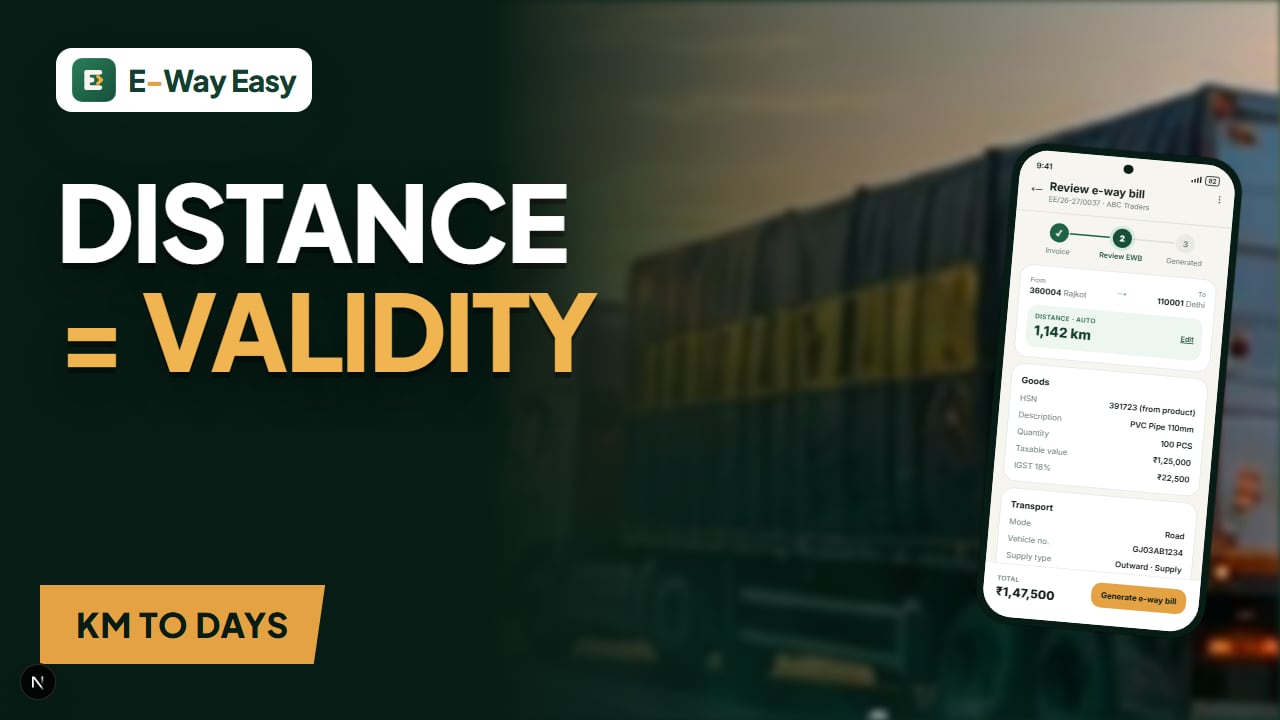
Table of contents
- Why distance matters
- How the portal calculates distance
- Example (illustrative): the 10% allowance and a day boundary
- Example (illustrative): wrong PIN, short validity
- Where distance goes wrong
- Dispatch from a different location
- Bill-to and ship-to are different
- Transporter's godown legs
- Rail, air and ship
- What if distance turns out to be wrong?
- Common mistakes
- Make distance part of invoicing
- Official sources
Quick answer: Normal cargo gets 1 day of validity for every 200 km or part of it, so crossing a 200 km boundary adds a full day. The portal calculates the PIN-to-PIN distance and accepts up to 10% more, to a maximum of 4,000 km, so a wrong PIN code can cost you a day.
Two numbers decide how long your e-way bill stays valid: the time you generate it and the distance you enter. Time of generation is covered in E-Way Bill Validity Explained. This article is about distance — how the portal works it out, how much you can adjust it, and why a careless PIN code can leave your truck with one day less than it needs.
Why distance matters
Under Rule 138(10), validity for normal cargo is 1 day for every 200 km or part thereof (for over-dimensional cargo, 1 day per 20 km). So validity changes in steps:
| Distance (normal cargo) | Days of validity |
|---|---|
| 1 – 200 km | 1 |
| 201 – 400 km | 2 |
| 401 – 600 km | 3 |
| 601 – 800 km | 4 |
| 801 – 1,000 km | 5 |
Crossing a 200 km boundary adds a full day. Falling just below one takes a day away.
How the portal calculates distance
The e-way bill system calculates the distance between the dispatch-from PIN code and the ship-to PIN code, and shows it as a suggestion when you generate.
The rules the portal applies, as described in its documentation:
- You may enter an actual distance up to 10% more than the auto-calculated PIN-to-PIN distance (to allow for real road routes, diversions and so on).
- The maximum distance that can be entered is 4,000 km.
- Where the dispatch and delivery PIN codes are the same, you can enter a distance of up to 100 km.
Check the current limits in the user documentation, as validations can be revised.
Example (illustrative): the 10% allowance and a day boundary
A Morbi ceramic tile unit ships tiles to a dealer. The portal calculates PIN-to-PIN distance as 380 km.
- Maximum distance allowed = 380 + 10% = 418 km
- At 380 km → 380 ÷ 200 = 1.9 → 2 days
- At 418 km → 418 ÷ 200 = 2.09 → 3 days
If the transporter's actual road route is 410 km (a highway diversion through a toll route, say), entering 410 km is both truthful and within the 10% allowance, and it gives 3 days instead of 2.
Entering more than the real route distance just to gain a day is not appropriate — the allowance exists for genuine route differences, and you should be able to justify the figure.
Example (illustrative): wrong PIN, short validity
A Ludhiana bicycle parts supplier ships to a buyer whose registered office is in one city but whose warehouse, where goods are actually delivered, is in an industrial area further away.
- Distance using the buyer's office PIN: 390 km → 2 days
- Distance using the actual warehouse PIN: 425 km → 3 days
Using the office PIN gives the truck 2 days for a trip that legitimately needs 3.
The ship-to PIN must be where goods are actually delivered. Using the billing address PIN is one of the most common causes of short validity — and it also misstates the place of delivery in Part A.
(Distances in these examples are illustrative.)
Where distance goes wrong
Dispatch from a different location
Your GSTIN may be registered at your office, but goods leave from a factory or godown. Use the PIN of the actual dispatch location. If that location is an additional place of business, make sure it is registered on your GST registration.
Bill-to and ship-to are different
In bill-to/ship-to transactions, the distance must be to the ship-to PIN.
Transporter's godown legs
For movements where goods go first to a transporter's godown and then onward, the e-way bill should reflect the full movement from consignor to consignee. Within the same state, the first leg up to 50 km to the transporter's place doesn't need Part B — but the e-way bill itself, with Part A, still applies.
Rail, air and ship
For multimodal movements, the distance is the overall movement distance. Road legs before and after still count. Check the documentation for how the portal treats each mode.
What if distance turns out to be wrong?
- Before goods move, within 24 hours: cancel and generate a fresh e-way bill with the correct distance. Distance cannot be edited on a generated bill.
- In transit, running late: if exceptional circumstances apply (accident, calamity, law and order, trans-shipment), extend validity within 8 hours before or after expiry. The portal will ask for current location and remaining distance.
- Already expired, outside the window: see What to Do When an E-Way Bill Expires.
Common mistakes
- Using registered office PIN instead of the actual dispatch location.
- Using billing address PIN instead of the delivery location.
- Accepting the suggestion blindly when the actual route is genuinely longer — losing a day you were entitled to.
- Padding distance beyond the real route — the 10% is an allowance for real routes, not a buffer.
- Forgetting the day boundaries. Know where 200, 400, 600 km fall for your common routes.
- Not rechecking after a delivery address change. If the buyer changes the delivery site, the e-way bill must reflect it.
Make distance part of invoicing
The cleanest fix is to settle the PIN codes and distance when the invoice is raised. In the E-Way Easy app, the buyer's PIN fills from their GSTIN, and distance is calculated automatically from PIN codes — you can edit it manually if the actual route is longer. You can also check a route with the free distance calculator before dispatch.
Official sources
The validity rule is in Rule 138(10) of the CGST Rules on CBIC GST. Distance validations (10% allowance, maximum distance, same-PIN rule) are described in the E-Way Bill user documentation and on the E-Way Bill System.
Frequently asked questions
Can I enter any distance I want?
No. The portal calculates the PIN-to-PIN distance and allows you to enter up to 10% more than that figure. Higher entries are not accepted.
What if dispatch and delivery are in the same PIN code?
For movement within the same PIN code, you can enter a distance of up to 100 km.
Can I change the distance after generation?
Distance is part of the generated bill and cannot be edited. If it is materially wrong, cancel within 24 hours and generate again.
Sources and references
- E-Way Bill System (official portal)ewaybillgst.gov.in
- E-Way Bill user documentationdocs.ewaybillgst.gov.in
- CBIC GST (CGST Rules, Rule 138)cbic-gst.gov.in
This article is general information, not tax or legal advice. GST and e-way bill requirements depend on the transaction, applicable notifications and state-specific provisions. Check the official portals before you rely on it.
Written by
Bhavesh AkabariBhavesh Akabari writes the E-Way Easy guides on e-way bills, GST invoicing and day-to-day compliance workflows for Indian manufacturers, wholesalers and traders. Every compliance article is checked against official GST and e-way bill sources and carries a "last verified" date.
Related articles
What to Do When an E-Way Bill Expires
Goods stuck on the road and the e-way bill about to lapse? Learn the 8-hour extension window, how validity is recalculated and what to avoid.
By Bhavesh Akabari · · 5 min read
E-Way Bill Part A and Part B Explained
What goes into Part A and Part B of Form GST EWB-01, who fills each part, when Part B can be skipped, and how to correct mistakes in either part.
By Bhavesh Akabari · · 5 min read
E-Way Bill Rules for Returns and Other Special Transactions
How to approach e-way bills for sales returns, supply on approval, exhibitions, bill-to-ship-to deals, line sales and goods sent in SKD/CKD lots.
By Bhavesh Akabari · · 6 min read