E-Way Bill vs Sales Invoice: Key Differences
A clear comparison of the e-way bill and the sales (tax) invoice: purpose, legal basis, who issues them, when they are needed, contents, validity, cancellation, and how they work together.
Last verified against official sources: 10 Oct 2026
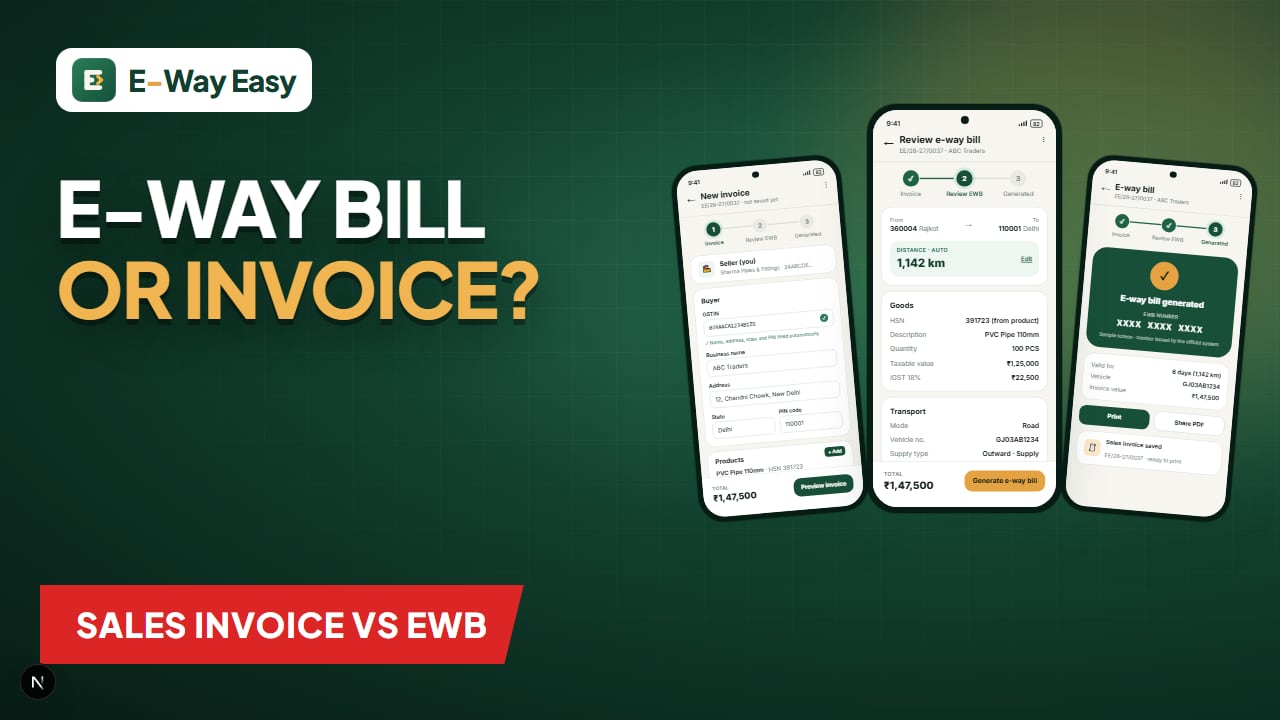
Table of contents
- E-way bill vs tax invoice: side-by-side comparison
- What each document does
- How they work together
- When you need one but not the other
- Fields that must match
- Which document is used for what
- Different rules for different documents
- E-invoice is a third, separate thing
- Example (illustrative)
- Common mix-ups
- Where E-Way Easy fits
- Official sources
Quick answer: A sales invoice records a sale and the GST charged on it; an e-way bill records the movement of goods. Every taxable supply by a registered person needs an invoice, while an e-way bill is generally needed only when goods above ₹50,000 move. One does not replace the other.
A sales invoice and an e-way bill often carry the same buyer, the same goods and the same value, so it is easy to treat them as one document. They are not. The invoice records a sale and the tax on it; the e-way bill records a movement of goods. You often need both, sometimes only one.
Under GST, the sales invoice a registered supplier issues for a taxable sale is the tax invoice, so "e-way bill vs tax invoice" and "e-way bill vs sales invoice" are the same question. This guide uses both terms.
E-way bill vs tax invoice: side-by-side comparison
| Point | Sales (tax) invoice | E-way bill |
|---|---|---|
| Purpose | Records a supply and the GST charged | Records movement of goods for tracking and verification |
| Legal basis | Section 31 of the CGST Act and Rule 46 of the CGST Rules | Section 68 of the CGST Act and Rule 138 of the CGST Rules |
| Issued by | Registered supplier | Supplier, recipient or transporter, on the official e-way bill system |
| Where created | Your billing or accounting software, or on paper | Only on the official e-way bill system (portal, SMS, official app, bulk upload, authorised API, or via IRN) |
| Needed for | Every taxable supply by a registered person | Movement of goods where consignment value exceeds ₹50,000, plus specific cases irrespective of value |
| Needed for services? | Yes | No — goods only |
| Needed for non-sale movement? | No (a delivery challan is used) | Often yes, against the delivery challan |
| Identifier | Your invoice number in your own series | 12-digit EWB number from the system |
| Key extra contents | Seller/buyer details, item-wise tax, place of supply, signature | Dispatch and delivery PINs, distance, transporter, vehicle number |
| Validity | No expiry | 1 day per 200 km (normal cargo) |
| Cancellation | Through accounting, credit note after reporting | Within 24 hours on the portal |
| Editing | Corrected through credit/debit notes | Part A cannot be edited; Part B can be updated |
| Carried with goods | Yes | Yes (printout, number, or RFID mapping) |
| Reported in returns | Yes, in GSTR-1 | Data compared with returns |
| Recipient action | Records it and claims input tax credit | May accept or reject within 72 hours or till delivery, whichever is earlier |
What each document does
The tax invoice is the primary document for a taxable supply. It fixes the value, the tax charged and the parties, and it is the basis for the supplier's output tax and the buyer's input tax credit. Rule 46 lists the particulars it must contain — supplier and recipient details and GSTINs, invoice number and date, HSN or SAC, description, quantity, taxable value, rate and amount of tax, place of supply and more. For goods, invoices are generally prepared in triplicate: original for the recipient, duplicate for the transporter and triplicate for the supplier.
The e-way bill (Form GST EWB-01) is the record of the movement. Part A carries details drawn from the invoice; Part B carries the vehicle or transport document. It lets officers check on the road that the goods in the vehicle match a declared supply. It is generally required where the consignment value — taxable value plus GST, excluding exempt supplies on the same invoice — exceeds ₹50,000. Some states have notified a different limit for movement within the state, so check your state's notification. It is also required irrespective of value for inter-state movement from a principal to a job worker, and for inter-state movement of specified handicraft goods by persons exempt from registration.
How they work together
- You issue the invoice (or challan).
- You generate the e-way bill using the invoice details: document number, date, GSTINs, HSN, value and tax come straight from the invoice.
- You add movement details: PIN codes, distance, transporter, vehicle.
- The driver carries both.
Because the e-way bill is built on the invoice, an error in the invoice usually flows into the e-way bill. Finalise and check the invoice first; if the invoice changes after the e-way bill is generated, the two no longer match.
When you need one but not the other
| Situation | Invoice | E-way bill |
|---|---|---|
| Sale of goods worth ₹30,000 including GST, same state | Yes | Generally no (check state threshold) |
| Sale of goods worth ₹1,50,000 by truck | Yes | Yes |
| Consulting service of ₹2,00,000 | Yes | No (services) |
| Stock transfer to own branch in same state, ₹80,000 | No (delivery challan, or invoice if distinct person rules apply) | Yes, against the challan |
| Inter-state job work, ₹20,000 | No (delivery challan) | Yes, irrespective of value |
| Goods by non-motorised cart | Yes | No (exempt situation) |
| Over-the-counter sale, customer carries goods below the threshold | Yes | No |
| Goods sent on approval or for an exhibition | No (delivery challan) | Yes, against the challan, if the value or rules require it |
Situations where no e-way bill is needed at all are listed in the Annexure to Rule 138(14), such as movement by non-motorised conveyance and certain exempt goods. For a quick first check on a specific consignment, use the e-way bill eligibility checker, then confirm your state's current notification. Returns and other special movements are covered in e-way bill rules for returns and special transactions.
Fields that must match
Because the e-way bill is built on the invoice, certain details must be identical in both. A mismatch is one of the first things noticed during verification.
| Field | On the invoice | On the e-way bill |
|---|---|---|
| Document number | Your invoice number | Same, character for character |
| Document date | Invoice date | Same date |
| Supplier GSTIN | Printed in seller details | Same |
| Recipient GSTIN | Printed in buyer details | Same (or URP if unregistered) |
| HSN | Per item | Same per item |
| Quantity and unit | Per item | Same |
| Taxable value | Per item and total | Same |
| Tax amounts | CGST/SGST or IGST, cess | Same |
| Ship-to address | If printed | Matches the delivery PIN |
Fields that appear only on the e-way bill — distance, transporter, vehicle number, transport document — have no equivalent on the invoice, though many businesses print the vehicle number on the invoice for convenience.
Which document is used for what
| Use | Invoice | E-way bill |
|---|---|---|
| Buyer's input tax credit | Yes — the buyer needs the invoice | No |
| Reporting outward supplies in GSTR-1 | Yes | Not directly; data is compared |
| Showing at a checkpoint | Yes, carried with goods | Yes, carried with goods |
| Proof of movement and route | Limited | Yes |
| Proof of delivery | No (use signed LR or receipt) | No (but recipient acceptance helps) |
| Payment follow-up | Yes | No |
Different rules for different documents
A sale is not always billed on a tax invoice, and the base document for the e-way bill changes with it:
- Bill of supply — composition dealers and suppliers of exempt goods issue this instead of a tax invoice. The e-way bill is generated against it when required.
- Delivery challan — used where there is no sale at the time of movement: job work, supply on approval, line sales, SKD/CKD lots, stock transfer without sale. The e-way bill is generated against the challan, and the tax invoice (if any) follows later. See delivery challan vs tax invoice.
- Bill of entry — for imported goods moving inland from a port or customs station.
E-invoice is a third, separate thing
For taxpayers covered by e-invoicing, the tax invoice is reported to the Invoice Registration Portal and gets an IRN. The e-way bill can then be generated using that IRN, with Part A filled from the e-invoice data. The e-invoice does not replace the e-way bill, and the e-way bill does not replace the e-invoice. As reported by GSTN, from 1 April 2025 taxpayers with AATO of ₹10 crore and above must report e-invoices within 30 days of the invoice date.
Example (illustrative)
A Rajkot pipe manufacturer (GSTIN 24ABCDE1234F1Z5) sells pipes to an Ahmedabad builder:
- Invoice RPM/26-27/0412: taxable value ₹1,20,000, CGST ₹10,800, SGST ₹10,800, total ₹1,41,600, with buyer GSTIN, HSN and place of supply Gujarat.
- E-way bill: built from the same invoice, plus dispatch PIN, ship-to PIN, about 220 km, vehicle GJ03AB1234. Valid for 2 days.
If the buyer later returns some pipes, the manufacturer issues a credit note against the invoice, and the return movement may need its own e-way bill (sub-type sales return) if above the threshold.
Common mix-ups
- Thinking the e-way bill number is the invoice number.
- Treating the e-way bill as proof of sale. Input tax credit and output tax rest on the invoice.
- Generating an e-way bill and forgetting to issue a proper invoice.
- Generating the e-way bill before the invoice is final, then changing the invoice.
- Splitting one sale into several invoices to stay under the threshold. Officers look at the substance of the movement, and this can create bigger problems.
- Not carrying the invoice because "the e-way bill has everything".
- Cancelling an e-way bill and assuming the sale is reversed in accounts.
- Treating an e-invoice IRN as an e-way bill, or assuming e-invoicing removes the e-way bill requirement.
Where E-Way Easy fits
In the E-Way Easy app, the sales invoice is created as part of the e-way bill workflow — Invoice → Review EWB → Generated — with an invoice preview before saving. That keeps the two documents consistent. If you only need an invoice, the free sales invoice templates and the GST tax invoice template are available on this site.
Official sources
Invoice requirements are in Section 31 of the CGST Act and Rule 46 of the CGST Rules; e-way bill requirements are in Section 68 and Rule 138. Read the current text on CBIC GST, and check e-way bill procedures on the official portal.
Frequently asked questions
Can an e-way bill replace an invoice?
No. The invoice (or bill of supply or delivery challan) must travel with the goods along with the e-way bill. The e-way bill is based on the invoice, not a substitute for it.
Do I need an invoice for every e-way bill?
You need a base document: a tax invoice, bill of supply, delivery challan, bill of entry or other permitted document, depending on the movement.
Is a sales invoice needed even when no e-way bill is required?
Yes. A registered supplier must issue a tax invoice (or bill of supply) for a taxable supply regardless of value. The e-way bill depends on the value and type of movement.
Is an e-invoice the same as an e-way bill?
No. An e-invoice is a tax invoice reported to the Invoice Registration Portal to get an IRN. An e-way bill is a movement document. For e-invoice taxpayers, the e-way bill can be generated using the IRN.
Do I need an e-way bill for every tax invoice?
No. An e-way bill is needed only when goods move and the consignment value exceeds the threshold (generally ₹50,000), or in specific cases where it is required irrespective of value. Invoices for services never need one.
Is the e-way bill number printed on the invoice?
It is not mandatory, but many businesses note it on their copy for easy tracking.
Sources and references
- CBIC GST (CGST Act and Rules)cbic-gst.gov.in
- E-Way Bill System (official portal)ewaybillgst.gov.in
- GST portalwww.gst.gov.in
This article is general information, not tax or legal advice. GST and e-way bill requirements depend on the transaction, applicable notifications and state-specific provisions. Check the official portals before you rely on it.
Editorial update history
- Merged our separate article on e-way bill vs tax invoice into this guide
- First published.
Written by
Bhavesh AkabariBhavesh Akabari writes the E-Way Easy guides on e-way bills, GST invoicing and day-to-day compliance workflows for Indian manufacturers, wholesalers and traders. Every compliance article is checked against official GST and e-way bill sources and carries a "last verified" date.
More e-way bill guides
Documents and Data Required for E-Way Bill Generation
Documents and data you need to generate an e-way bill, split into Part A and Part B, plus what the driver must carry and a printable checklist.
How to Generate an E-Way Bill: Complete Process
Step-by-step process to generate an e-way bill on the official portal: login, Generate New, transaction type, sub-type, document details, Part A, Part B, submit and print. Also covers SMS, app, API and IRN-based generation.
E-Way Bill Guide: Everything Indian Businesses Need to Know
A practical overview of the e-way bill system in India: what it is, when it is required, who generates it, how Part A and Part B work, validity, and links to every detailed guide.