Delivery Challan vs. Tax Invoice
Not every movement of goods is a sale. Learn when to issue a delivery challan instead of a tax invoice, what each must contain and how e-way bills fit in.
Last verified against official sources: 10 Oct 2026
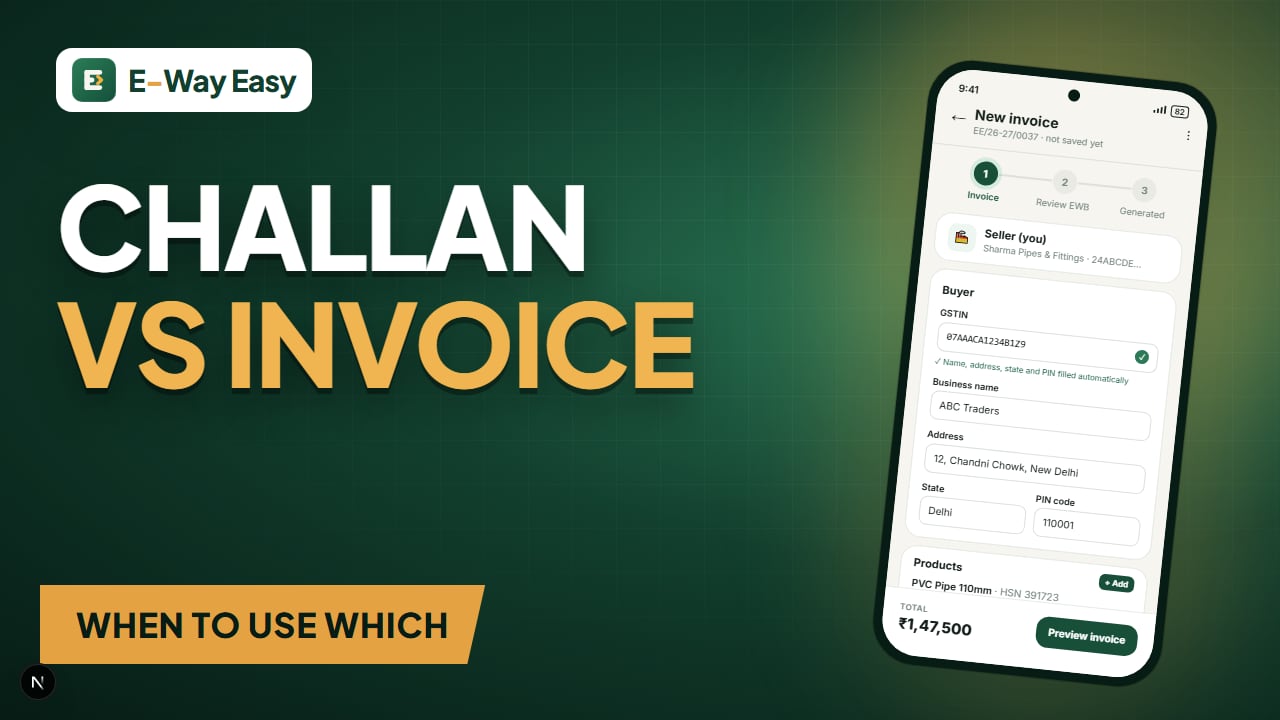
Table of contents
Quick answer: Issue a tax invoice when a taxable supply takes place. Issue a delivery challan when goods move without a sale, or the sale is not complete at removal, such as job work, supply on approval or a stock transfer. Where an e-way bill is needed, it is generated against whichever document applies.
Goods leave your premises for many reasons. Sometimes you are selling them. Sometimes you are sending them to a job worker for processing, to a customer on approval, to your own branch, or out with a sales van that will sell along the route. GST treats these differently, and the document you issue should reflect what is actually happening.
The rule of thumb: a tax invoice is for a supply; a delivery challan is for movement that is not (yet) a supply, or where the invoice cannot be issued at the time of removal.
The legal basis in brief
- Tax invoice: Section 31 of the CGST Act and Rule 46 of the CGST Rules, 2017.
- Delivery challan: Rule 55 of the CGST Rules, 2017.
Rule 55 allows a delivery challan to be issued, instead of an invoice, at the time of removal of goods in specified cases. The main ones are:
- Supply of liquid gas where the quantity at the time of removal is not known
- Transportation of goods for job work
- Transportation of goods for reasons other than by way of supply
- Other supplies as may be notified (such as goods sent on approval)
The rule also covers goods moved in semi-knocked down (SKD) or completely knocked down (CKD) condition in several lots, where the full invoice is issued before the first consignment and each lot moves with a delivery challan.
Side-by-side comparison
| Point | Tax invoice | Delivery challan |
|---|---|---|
| Used when | A taxable supply of goods takes place | Goods move without a sale, or the sale is not complete at removal |
| Tax charged? | Yes, shown on the document | No tax liability arises from the challan itself |
| Basis for ITC | Yes, for the recipient | No |
| Typical cases | Normal sales, inter-state sales, exports | Job work, approval sales, line sales, stock transfers within the same GSTIN, exhibitions, SKD/CKD lots |
| Copies (goods) | Original — recipient; duplicate — transporter; triplicate — supplier | Original — consignee; duplicate — transporter; triplicate — consignor |
| Serial number | Consecutive series, unique for the financial year | Consecutive series, unique for the financial year |
| E-way bill basis? | Yes | Yes |
Note: A stock transfer to a branch in another state is generally treated as a supply between distinct persons (different GSTINs), so it usually needs a tax invoice, not just a challan. Within the same state and same GSTIN, a delivery challan is typical. Confirm the treatment for your situation.
What a delivery challan should contain
Rule 55 lists the particulars. In practical terms, your challan should have:
- Date and number (consecutive, unique series not exceeding 16 characters)
- Name, address and GSTIN of the consignor
- Name, address and GSTIN (or UIN) of the consignee, if registered
- HSN code and description of goods
- Quantity (provisional where exact quantity is not known)
- Taxable value
- Tax rate and tax amount — where the transportation is for supply to the consignee
- Place of supply, in the case of inter-state movement
- Signature
Many businesses print "Not a tax invoice" or the purpose (for example, "Sent for job work") on the challan to avoid confusion at the receiving end.
Example (illustrative): job work and final sale
A Ludhiana hosiery unit sends 2,000 kg of yarn to a job worker in Tiruppur for knitting. Later, it sells the finished fabric to a garment exporter in Mumbai.
Movement 1 — yarn to the job worker (Punjab → Tamil Nadu)
| Item | Detail |
|---|---|
| Document | Delivery challan DC/26/041 |
| Purpose | Sent for job work |
| Value of yarn | ₹4,60,000 |
| Tax on document | Not charged as a supply |
| E-way bill | Required — inter-state movement from principal to job worker needs one irrespective of value |
Movement 2 — fabric back from the job worker
The job worker returns the knitted fabric to Ludhiana. This return movement is also covered by a challan, and an e-way bill is needed where the conditions apply. Our article on e-way bill rules for job work covers who generates it.
Movement 3 — sale to the Mumbai exporter (Punjab → Maharashtra)
| Item | Amount |
|---|---|
| Fabric, 1,750 kg × ₹380 | ₹6,65,000 |
| IGST @ 5% (illustrative rate) | ₹33,250 |
| Invoice total | ₹6,98,250 |
This is a supply, so a tax invoice is issued with IGST (inter-state), and an e-way bill is generated against that invoice.
Three movements, two document types, three e-way bills — and each document matches what was actually happening at the time.
Supply on approval and line sales
Goods sent on approval: When a jeweller or machinery dealer sends goods to a customer to inspect before buying, the sale is not complete at removal. A delivery challan covers the movement. If the customer accepts, a tax invoice is issued. GST law sets a time limit for issuing the invoice in such cases, so check the current provision.
Line sales / sales van: Where the quantity to be sold to each customer is not known at dispatch, goods can move under a delivery challan and invoices are raised as each sale is made on the route.
Common mistakes
- Using a challan for an actual sale to delay tax. If ownership passes and consideration is agreed, it is a supply and needs an invoice.
- Using an invoice for job work. Sending goods to a job worker is not a sale; an invoice charging GST here confuses both parties' books.
- Forgetting the e-way bill for job work. Inter-state movement to a job worker needs an e-way bill irrespective of value.
- Not converting approval challans into invoices within the time limit.
- Mixing challan and invoice series. Keep separate, consecutive series.
- Leaving out value on the challan. Even without tax, the value is needed and drives the e-way bill.
Which one do I need? A quick check
- Is ownership passing for a price right now? → Tax invoice
- Are goods going for job work, on approval, for exhibition, or to your own place within the same GSTIN? → Delivery challan
- Is the exact quantity unknown at dispatch (liquid gas, line sales)? → Delivery challan, invoice later
- Is it an inter-state transfer to your own branch with a different GSTIN? → Usually tax invoice; confirm
Whatever the document, check whether the movement needs an e-way bill using our eligibility checker.
Where E-Way Easy helps
The E-Way Easy app is built around the sales invoice: you create the invoice and review the e-way bill details in one flow. For challan-based movements, prepare the challan as per Rule 55 and use the official e-way bill system. Our free GST tax invoice template is useful for quick one-off invoices.
Official sources
Invoice rules are in Section 31 and Rule 46; delivery challan rules are in Rule 55 of the CGST Rules, 2017. Read the current text on cbic-gst.gov.in and the GST tutorials at tutorial.gst.gov.in. For e-way bill requirements, see ewaybillgst.gov.in.
Sources and references
- CBIC GST (Acts and Rules)cbic-gst.gov.in
- E-Way Bill System (official portal)ewaybillgst.gov.in
- GST tutorialstutorial.gst.gov.in
This article is general information, not tax or legal advice. GST and e-way bill requirements depend on the transaction, applicable notifications and state-specific provisions. Check the official portals before you rely on it.
Written by
Bhavesh AkabariBhavesh Akabari writes the E-Way Easy guides on e-way bills, GST invoicing and day-to-day compliance workflows for Indian manufacturers, wholesalers and traders. Every compliance article is checked against official GST and e-way bill sources and carries a "last verified" date.
Related articles
E-Way Bill Rules for Job Work
When goods go to a job worker and come back, who generates the e-way bill, which document travels with the goods, and why interstate job work needs one at any value.
By Bhavesh Akabari · · 5 min read
E-Way Bill Rules for Returns and Other Special Transactions
How to approach e-way bills for sales returns, supply on approval, exhibitions, bill-to-ship-to deals, line sales and goods sent in SKD/CKD lots.
By Bhavesh Akabari · · 6 min read
How to Avoid Errors in Invoice and Transport Details
The invoice and transport errors that most often cause e-way bill cancellations and roadside trouble, and a pre-dispatch checklist to catch them.
By Bhavesh Akabari · · 6 min read