E-Way Bill Rules for Job Work
When goods go to a job worker and come back, who generates the e-way bill, which document travels with the goods, and why interstate job work needs one at any value.
Last verified against official sources: 10 Oct 2026
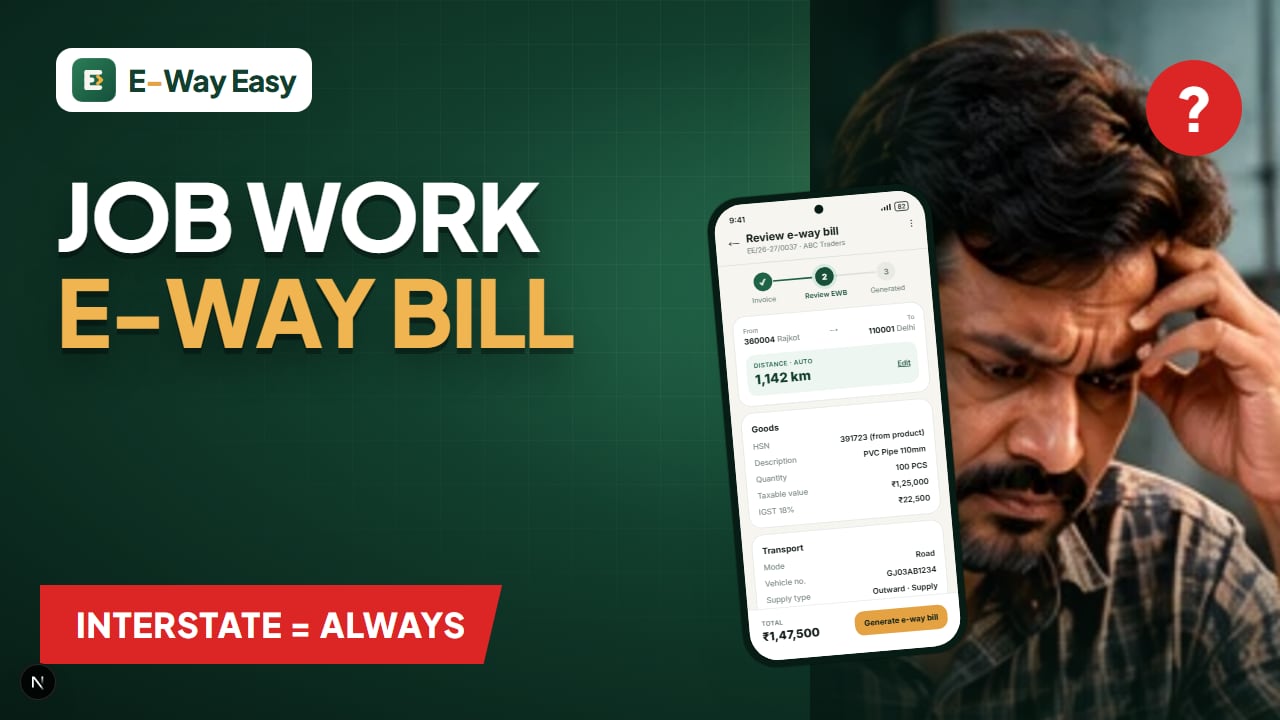
Table of contents
Quick answer: For inter-state movement from a principal to a job worker, an e-way bill is required at any value, generated by the principal or a registered job worker against a delivery challan. For job work within a state, the normal threshold applies: generally ₹50,000, or the limit your state has notified.
Job work is common in Indian manufacturing: a textile trader sends grey fabric for dyeing, an engineering unit sends castings for machining, a garment brand sends cut pieces for stitching. Goods leave the principal's premises, are processed, and come back — or go straight to a buyer. Because no sale takes place when goods go out, many businesses assume the e-way bill rules do not apply. That assumption is the most common job work mistake.
The key rule
Under the first proviso to Rule 138(1) of the CGST Rules, where goods are sent by a principal located in one state or union territory to a job worker located in another, an e-way bill must be generated irrespective of the value of the consignment. It can be generated:
- by the principal, or
- by the job worker, if the job worker is registered.
For intrastate job work (principal and job worker in the same state), the normal threshold applies — ₹50,000 generally, or the limit notified by your state for intrastate movement. Check your state's notification.
Who does what
| Movement | Document | E-way bill required? | Usually generated by |
|---|---|---|---|
| Principal → job worker, different states | Delivery challan | Yes, at any value | Principal, or registered job worker |
| Principal → job worker, same state | Delivery challan | If value crosses the applicable threshold | Principal (or transporter/job worker as applicable) |
| Job worker → principal (return after processing) | Delivery challan | If value crosses the applicable threshold | Job worker if registered, or principal/transporter |
| Job worker → another job worker | Delivery challan | Same tests as above | Principal or registered job worker |
| Job worker → principal's buyer (direct supply) | Tax invoice issued by the principal | If value crosses the threshold | Principal (or as per arrangement) |
Note: The "irrespective of value" rule is specifically for goods sent by a principal to a job worker across states. For the return leg and other movements, apply the ordinary threshold, and verify the current position with your adviser.
The delivery challan
Because job work is not a supply, the document that travels with the goods is a delivery challan under Rule 55 of the CGST Rules, not a tax invoice. A delivery challan should carry, among other details:
- Date and a serially numbered challan number
- Name, address and GSTIN of the consignor
- Name, address and GSTIN (if registered) of the consignee
- HSN code and description of goods
- Quantity
- Taxable value
- Tax rate and tax amount where the movement is a supply (for job work this is generally shown for reference)
- Place of supply, in case of interstate movement
- Signature
When generating the e-way bill, choose the delivery challan as the document type and the job work option as the reason (sub-type). For the return leg, the portal provides a job work return option.
Valuing the challan
Value the goods realistically — typically the value of the inputs or semi-finished goods sent. Undervaluing the challan to stay under a threshold does not work for interstate job work anyway, and a value that looks wrong invites questions during inspection.
Step-by-step: sending goods for interstate job work
- Raise the delivery challan in your own series, with the job worker's GSTIN or details.
- Generate the e-way bill with Part A from the challan: both GSTINs, delivery PIN, challan number and date, value, HSN, reason "Job Work".
- Fill Part B with the vehicle number.
- Send the goods with the challan (the GST rules require the challan in triplicate for movement — original for the consignee, duplicate for the transporter, triplicate retained by the consignor).
- Record the movement in your job work register so you can track the time limits for return of goods and report as required in your returns.
Example (illustrative)
A Bhiwandi textile trader (GSTIN 27ABCDE1234F1Z5) sends 600 metres of grey fabric, valued at ₹42,000, to a dyeing unit in Surat (GSTIN 24ABCDE1234F1Z5).
- The value is below ₹50,000, but this is interstate movement from principal to job worker, so an e-way bill is required.
- The trader issues delivery challan
DC/26-27/0118. - The e-way bill is generated with document type "Delivery Challan", reason "Job Work", delivery PIN of the dyeing unit, and the tempo's vehicle number in Part B.
Two weeks later, the dyed fabric (value ₹42,000 for the principal's goods; the dyer separately invoices its job work charges) is sent back. For this return leg, the dyeing unit checks whether the value crosses the applicable threshold. If it does not, and no other condition applies, an e-way bill may not be required — but the goods still travel with a delivery challan. If the dyer's practice is to generate one anyway for interstate returns, there is no harm in doing so.
Separately, the dyer issues a tax invoice for its job work service charges, with GST as applicable.
Common mistakes
- No e-way bill because "it's not a sale". For interstate principal-to-job-worker movement, value and the absence of a sale do not matter.
- Using a tax invoice instead of a delivery challan. This can make the movement look like a sale and create a mismatch in returns.
- Wrong reason code. Selecting "Supply" instead of the job work option misdescribes the movement.
- Unregistered job worker generating the e-way bill. For interstate movement, the job worker can generate it only if registered. Otherwise, the principal should.
- Losing track of goods at the job worker. Inputs and capital goods sent for job work must come back within time limits specified in the law; otherwise the movement may be treated as a supply. Keep a register.
- Forgetting the job worker's own charges. The job worker's service invoice is separate from the movement documents.
Limitations
This article covers the e-way bill side of job work. The wider job work provisions — Section 143 of the CGST Act, time limits for return of inputs and capital goods, and reporting requirements — have their own conditions. Discuss your specific arrangement with a tax adviser, especially if goods move directly from the job worker to buyers or between multiple job workers.
Helpful links
- Delivery challan vs tax invoice
- Who is responsible for generating an e-way bill
- E-way bill requirements for interstate movement
- Documents required for e-way bill
Official sources
Read the current text of Rule 138 and Rule 55 on CBIC GST or CBIC, and see the E-Way Bill System and GST tutorials for how to select job work options when generating.
Frequently asked questions
Is an e-way bill needed if I send ₹15,000 worth of goods to a job worker in another state?
Yes. For interstate movement from a principal to a job worker, Rule 138 requires an e-way bill irrespective of the consignment value.
Can the job worker generate the e-way bill?
For interstate movement from principal to job worker, the e-way bill can be generated by the principal, or by the job worker if registered.
Which document should travel with goods sent for job work?
A delivery challan, because sending goods for job work is not a sale. The e-way bill is generated against the delivery challan.
Sources and references
- E-Way Bill System (official portal)ewaybillgst.gov.in
- CBIC GSTcbic-gst.gov.in
- CBICwww.cbic.gov.in
- GST tutorialstutorial.gst.gov.in
This article is general information, not tax or legal advice. GST and e-way bill requirements depend on the transaction, applicable notifications and state-specific provisions. Check the official portals before you rely on it.
Written by
Bhavesh AkabariBhavesh Akabari writes the E-Way Easy guides on e-way bills, GST invoicing and day-to-day compliance workflows for Indian manufacturers, wholesalers and traders. Every compliance article is checked against official GST and e-way bill sources and carries a "last verified" date.
Related articles
Delivery Challan vs. Tax Invoice
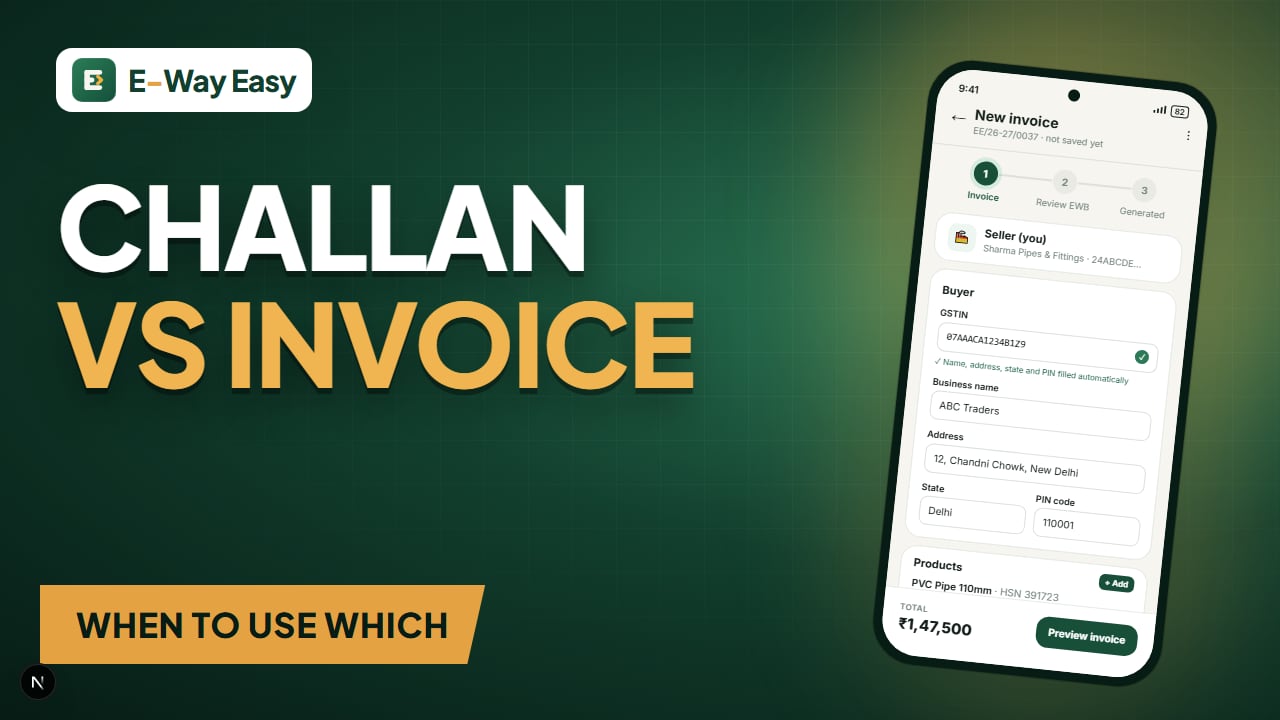
Not every movement of goods is a sale. Learn when to issue a delivery challan instead of a tax invoice, what each must contain and how e-way bills fit in.
By Bhavesh Akabari · · 6 min read
Who Is Responsible for Generating an E-Way Bill?
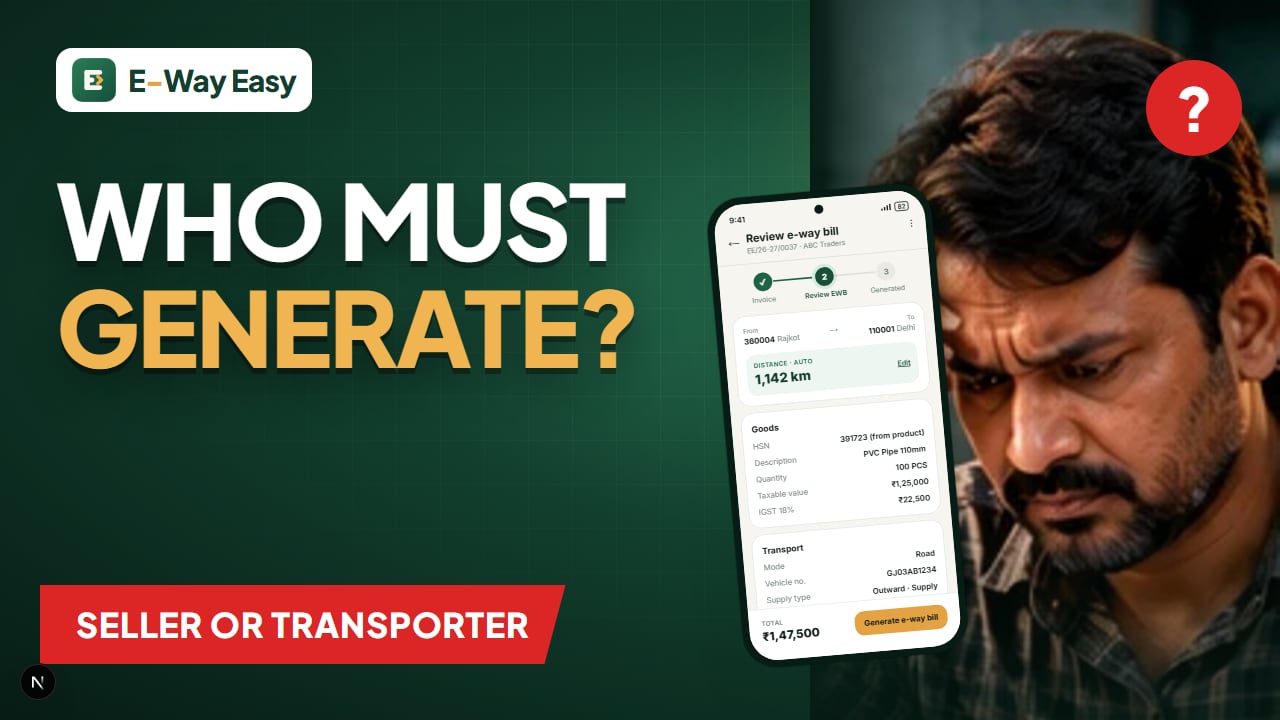
Supplier, recipient or transporter? How responsibility for the e-way bill is split, what each party must do, and how to avoid goods leaving without one.
By Bhavesh Akabari · · 5 min read
E-Way Bill Requirements for Interstate Movement
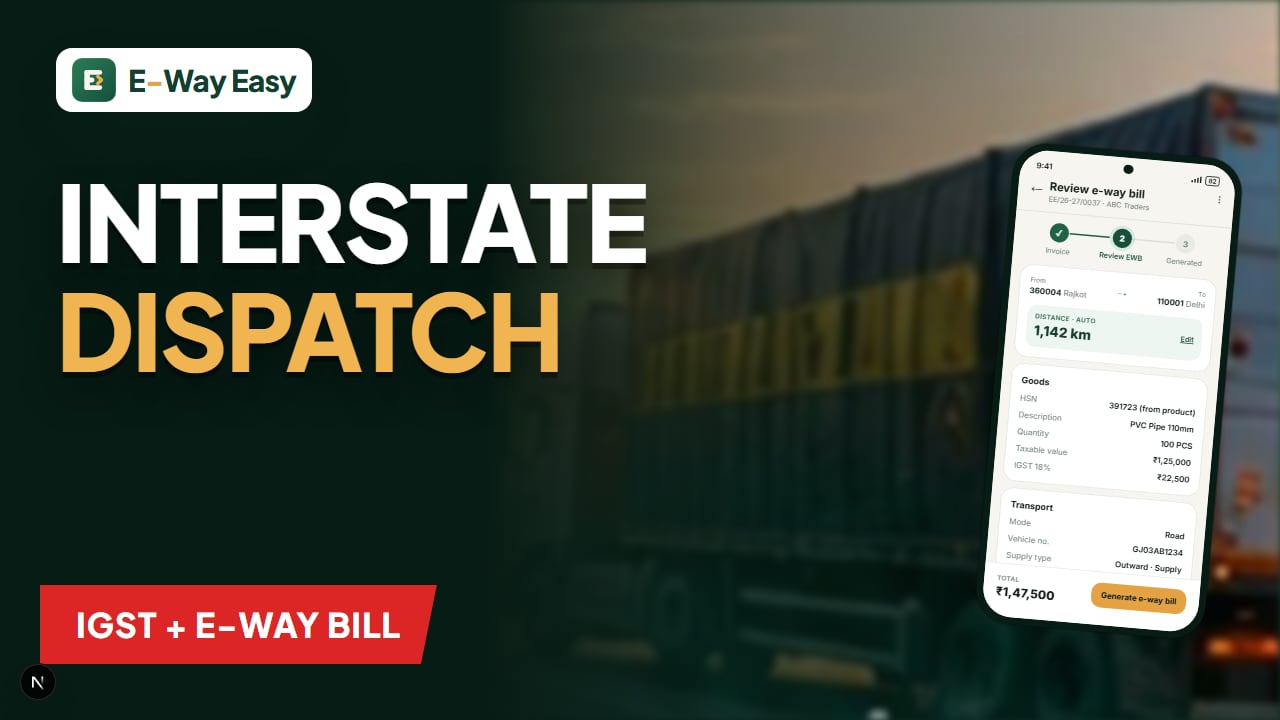
What changes when goods cross a state border: the ₹50,000 threshold, cases needing an e-way bill at any value, IGST, distance, validity and documents to carry.
By Bhavesh Akabari · · 6 min read