Who Is Responsible for Generating an E-Way Bill?
Supplier, recipient or transporter? How responsibility for the e-way bill is split, what each party must do, and how to avoid goods leaving without one.
Last verified against official sources: 10 Oct 2026
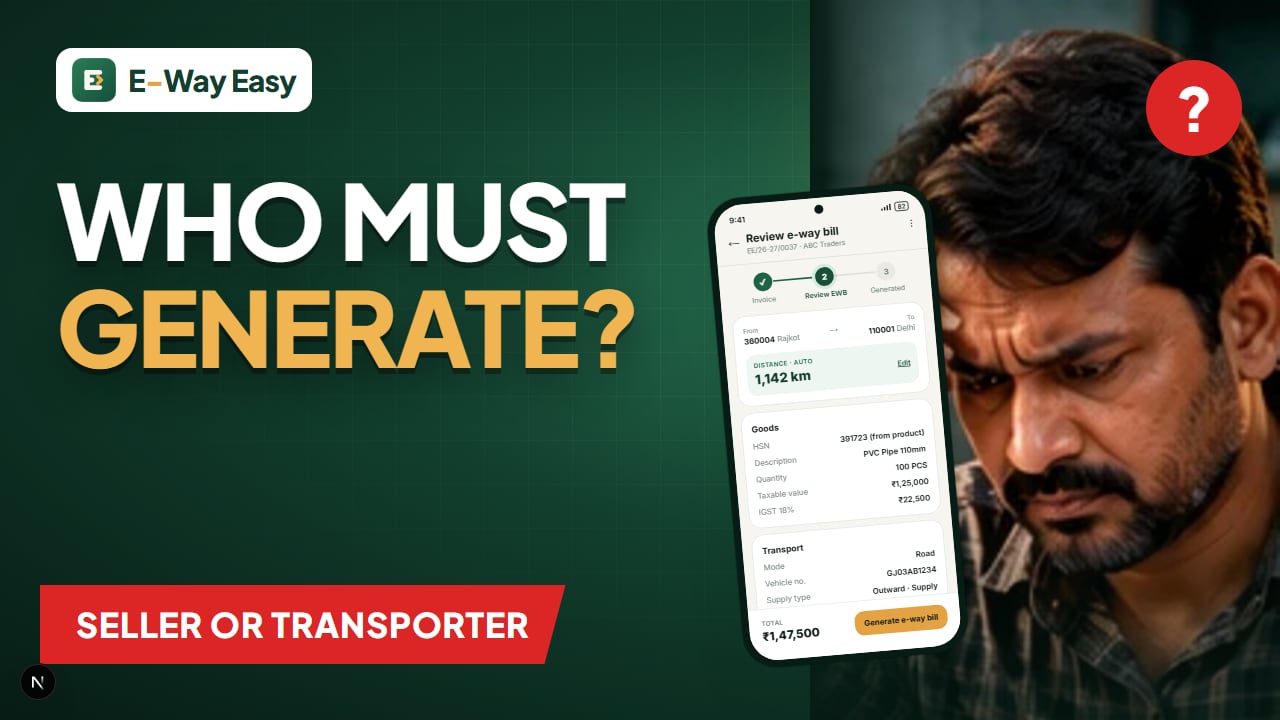
Table of contents
- The short answer
- Responsibility by party
- Scenario-by-scenario
- 1. Registered supplier sells and arranges transport
- 2. Buyer collects goods in their own vehicle
- 3. Supplier hands goods to a transporter without generating
- 4. Purchase from an unregistered supplier
- 5. Transporter not registered under GST
- 6. Goods changing vehicles mid-route
- Example (illustrative)
- Liability does not move with the task
- Who can cancel, update and extend
- Common mistakes
- Making the supplier side simple
- Official sources
Quick answer: The registered person causing the movement, usually the supplier or the recipient, generates the e-way bill. The transporter can generate it on their behalf, and must do so before the goods move if neither has generated it and the value exceeds the threshold.
"I thought the transporter was doing it." "The buyer said they would generate it." Most cases of goods travelling without an e-way bill start with a sentence like this. The rules allow three different parties to generate an e-way bill, which is flexible but also makes it easy for everyone to assume someone else has done it.
This article sets out who can generate, who must generate, and how to divide the job clearly.
The short answer
Under Rule 138 of the CGST Rules, the e-way bill can be generated by:
- The registered person causing the movement — usually the supplier (consignor), or the recipient (consignee) if the recipient is causing the movement.
- The transporter — on authorisation and on the basis of documents from the supplier or recipient.
And there is a fallback duty: where neither the supplier nor the recipient has generated an e-way bill and the consignment value exceeds the threshold, the transporter must generate it before the goods move.
Responsibility by party
| Party | Can generate? | Typical role | Key duty |
|---|---|---|---|
| Registered supplier | Yes | Generates Part A from their invoice; may also fill Part B | Correct invoice-level data |
| Registered recipient | Yes | Generates when they arrange transport or buy from unregistered suppliers | Accept or reject within 72 hours |
| Transporter (GSTIN or TRANSIN) | Yes | Fills or updates Part B; generates when parties haven't | Must not move goods above threshold without a valid e-way bill |
| Unregistered supplier | No (not as registered person) | — | Registered recipient takes responsibility |
Scenario-by-scenario
1. Registered supplier sells and arranges transport
This is the most common case. The supplier generates the e-way bill with Part A from their invoice and Part B with the vehicle number (or names the transporter so the transporter can fill Part B).
2. Buyer collects goods in their own vehicle
The registered recipient is causing the movement, so the recipient can generate the e-way bill. In practice the supplier often generates it anyway because they have the invoice data. Either is acceptable — but agree who will do it before the vehicle arrives.
3. Supplier hands goods to a transporter without generating
If the value exceeds the threshold and neither the supplier nor the recipient has generated it, the transporter must generate it before moving the goods, using the invoice or challan handed over.
4. Purchase from an unregistered supplier
If the recipient is registered, the movement is treated as caused by the recipient, who generates the e-way bill as an inward movement. The supplier's bill (or the recipient's own document, as applicable) is the base document.
5. Transporter not registered under GST
Many small transport operators are not registered. They enrol on the e-way bill portal to get a TRANSIN (Transporter ID), which can be entered on the e-way bill so they can update Part B.
6. Goods changing vehicles mid-route
Whoever is in charge — usually the transporter — updates Part B with the new vehicle details before the goods move in the new vehicle. Multiple consignments in one vehicle can be covered by a consolidated e-way bill (Form GST EWB-02), generated by the transporter.
Example (illustrative)
A Jaipur handicraft wholesaler sells goods to a retailer in Delhi. The invoice is ₹46,000 + 12% GST (₹5,520) = ₹51,520. The retailer's transporter collects the goods.
- Who is causing the movement? The supplier is making the supply; the recipient is arranging transport.
- Who should generate? Either the supplier or the recipient. The transporter must generate if neither does.
- Sensible arrangement: The wholesaler generates Part A from the invoice and enters the transporter's GSTIN/TRANSIN. The transporter fills Part B with the vehicle number on pickup.
- Result: One e-way bill, clear ownership, and the transporter cannot leave the premises without completing Part B.
(GST rate is illustrative; confirm the correct rate for your goods.)
Liability does not move with the task
Delegating generation to a transporter does not remove the supplier's or recipient's interest in getting it right. If the details are wrong or the bill is missing, goods and the vehicle can be detained, and a penalty under Section 129 can apply. The person who generated the bill may also need to explain discrepancies.
So even when someone else generates, check the e-way bill number and key details before the vehicle leaves.
Who can cancel, update and extend
- Cancel: the generator, within 24 hours, if goods were not moved or not moved as per details, and only if not verified in transit.
- Update Part B / change transporter: the generator or the assigned transporter, during validity.
- Extend validity: the generator or the transporter in charge, within 8 hours before or after expiry, for exceptional circumstances.
- Reject: the recipient, within 72 hours (or before delivery, if earlier).
Common mistakes
- No written agreement on who generates. Put it in the PO, transport contract or a dispatch SOP.
- Transporter ID not entered. The transporter can't update Part B if they aren't assigned.
- Recipient ignoring e-way bills against their GSTIN. Unchecked bills are deemed accepted after 72 hours.
- Supplier assuming the buyer's vehicle means no responsibility. The supplier's invoice data still drives Part A.
- Unregistered transporter without TRANSIN. Enrol on the portal before taking consignments that need e-way bills.
Making the supplier side simple
For most small suppliers, the realistic choice is to generate the e-way bill yourself at the time of invoicing. The E-Way Easy app is designed for that: invoice and e-way bill details are prepared together (Invoice → Review EWB → Generated), with buyer details filled from GSTIN and distance from PIN codes. It is an independent app, not a government portal — see how it simplifies the workflow.
Official sources
The responsibilities are set out in Rule 138 of the CGST Rules on CBIC GST. TRANSIN enrolment and transporter functions are explained on the E-Way Bill System and in the user documentation.
Frequently asked questions
Can a transporter generate the e-way bill on behalf of the supplier?
Yes. The transporter can generate it on the basis of the invoice or challan handed over by the supplier. If neither the supplier nor the recipient has generated it and the value exceeds the threshold, the transporter must do so before the movement.
What if my supplier is unregistered?
If you, the recipient, are registered, the movement is treated as caused by you and you can generate the e-way bill as an inward movement, provided the rules require one for that movement.
Do unregistered transporters need a GSTIN?
No. They can enrol on the e-way bill portal and get a Transporter ID (TRANSIN) to be named on e-way bills and to update Part B.
Sources and references
- E-Way Bill System (official portal)ewaybillgst.gov.in
- E-Way Bill user documentationdocs.ewaybillgst.gov.in
- CBIC GST (CGST Rules)cbic-gst.gov.in
This article is general information, not tax or legal advice. GST and e-way bill requirements depend on the transaction, applicable notifications and state-specific provisions. Check the official portals before you rely on it.
Written by
Bhavesh AkabariBhavesh Akabari writes the E-Way Easy guides on e-way bills, GST invoicing and day-to-day compliance workflows for Indian manufacturers, wholesalers and traders. Every compliance article is checked against official GST and e-way bill sources and carries a "last verified" date.
Related articles
What Is an E-Way Bill? A Complete Guide for Indian Businesses
A plain-English guide to the e-way bill: what it is, when you need one, who generates it, its two parts, validity and the mistakes that cause trouble on the road.
By Bhavesh Akabari · · 8 min read
E-Way Bill Part A and Part B Explained
What goes into Part A and Part B of Form GST EWB-01, who fills each part, when Part B can be skipped, and how to correct mistakes in either part.
By Bhavesh Akabari · · 5 min read
How to Update Vehicle Details in an E-Way Bill
Truck broke down or goods shifted to another vehicle? Here is how Part B of an e-way bill is updated, who can do it and what to check first.
By Bhavesh Akabari · · 6 min read