E-Way Bill Limit and the ₹50,000 Threshold: Rules and Exceptions
How the ₹50,000 e-way bill limit is calculated, what counts in consignment value, state thresholds, cases needing an e-way bill regardless of value, and exemptions.
Last verified against official sources: 10 Oct 2026
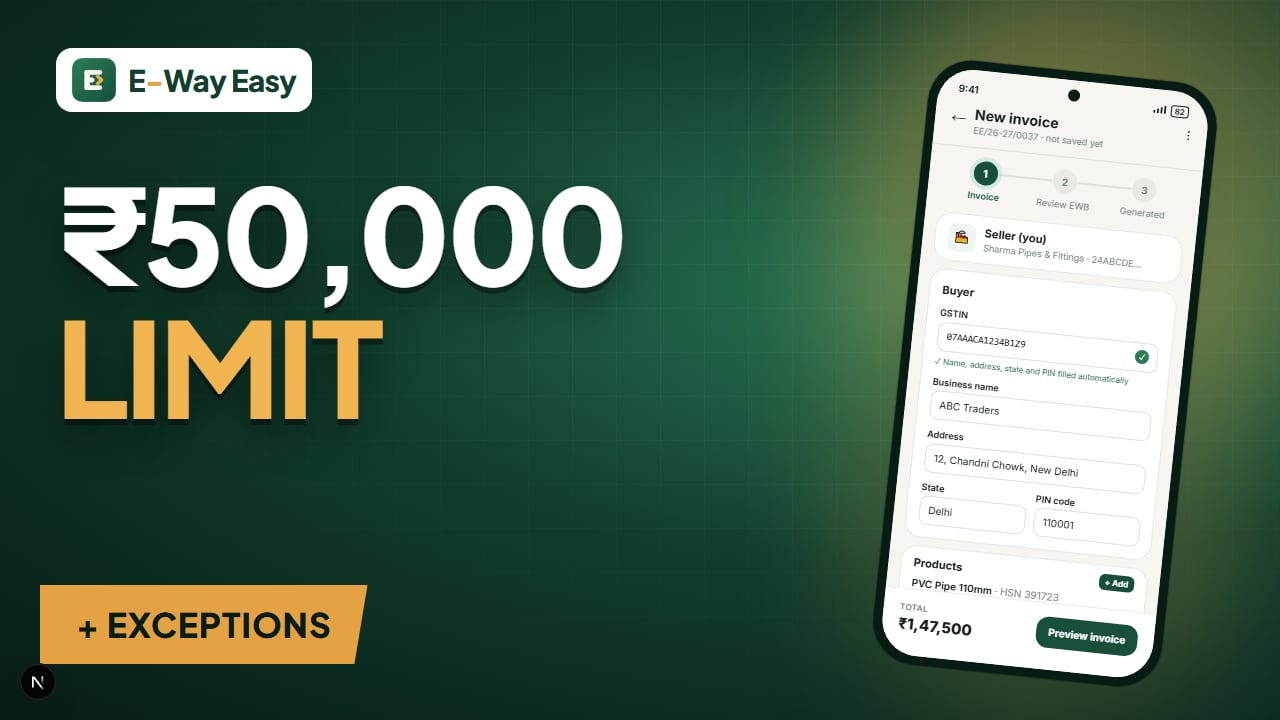
Table of contents
- The rule in one line
- What is "consignment value"?
- Worked calculations
- Example (illustrative) 1: tax pushes the value over the line
- Example (illustrative) 2: exempt items on the same invoice
- Example (illustrative) 3: exactly at the threshold
- State thresholds for intra-state movement
- When value doesn't matter: e-way bill required anyway
- When no e-way bill is required
- Splitting invoices: why it doesn't work
- Multiple invoices, one vehicle
- Common mistakes
- A practical habit
- Official sources
Quick answer: An e-way bill is generally required when consignment value exceeds ₹50,000. That value includes GST and cess but excludes exempt supplies on the same invoice. Some states have notified different intra-state limits, and some movements need one at any value, such as inter-state goods sent to a job worker.
"Above ₹50,000, you need an e-way bill" is the rule everyone remembers. What gets missed is the detail: which value is compared, whether GST counts, what happens with exempt items on the same invoice, and the cases where the value doesn't matter at all. This article works through each.
The rule in one line
An e-way bill is generally required for movement of goods where the consignment value exceeds ₹50,000 (Rule 138 of the CGST Rules, 2017).
Note "exceeds": a consignment of exactly ₹50,000 does not cross the general threshold.
What is "consignment value"?
Rule 138 defines it as the value of goods determined under Section 15 of the CGST Act, declared in the invoice, bill of supply or delivery challan, as the case may be. Put simply:
| Included | Excluded |
|---|---|
| Taxable value of goods | Value of exempt supplies in the same invoice |
| CGST + SGST, or IGST | |
| Cess, where applicable |
So the test is done on the invoice total with tax, minus any exempt items.
Worked calculations
Example (illustrative) 1: tax pushes the value over the line
A Ludhiana hosiery unit invoices knitwear:
- Taxable value: ₹45,000
- GST @ 12%: ₹5,400
- Consignment value: ₹50,400 → exceeds ₹50,000 → e-way bill required.
On taxable value alone (₹45,000) it looks like no e-way bill is needed. That is the most common error.
Example (illustrative) 2: exempt items on the same invoice
A Nashik agri-trader's invoice has two lines:
| Line | Value | GST | Total |
|---|---|---|---|
| Fertiliser sprayer (taxable) | ₹38,000 | ₹6,840 (18%) | ₹44,840 |
| Fresh vegetables (exempt) | ₹12,000 | — | ₹12,000 |
| Invoice total | ₹56,840 |
Consignment value for the e-way bill test = ₹56,840 − ₹12,000 (exempt) = ₹44,840, which does not exceed ₹50,000 under the general rule.
Example (illustrative) 3: exactly at the threshold
Taxable value ₹42,372.88 + 18% GST ₹7,627.12 = ₹50,000.00. Not "exceeding" ₹50,000 — no e-way bill required under the general rule. In practice, if your values hover at this line, many businesses generate voluntarily to avoid arguments at a checkpoint.
(Rates in these examples are illustrative; confirm the correct GST rate for your goods.)
Try your own figures with the e-way bill eligibility checker or the GST calculator.
State thresholds for intra-state movement
For movement within a state, some states have notified a different, higher threshold than ₹50,000, and some have specified it for particular goods or areas. Because these notifications vary and change, we don't list numbers here.
What to do: If your goods move only within your state, check your state's commercial tax department notification or the E-Way Bill System for the current intra-state limit. For inter-state movement, the ₹50,000 rule applies. See Intrastate Movement Considerations.
When value doesn't matter: e-way bill required anyway
An e-way bill is required irrespective of consignment value for:
- Inter-state movement of goods by a principal to a job worker — by the principal or the registered job worker. See E-Way Bill Rules for Job Work.
- Inter-state transport of specified handicraft goods by a person exempt from registration.
When no e-way bill is required
The Annexure to Rule 138(14) and related provisions list movements where an e-way bill is not required. Some commonly referenced cases:
- goods transported by non-motorised conveyance;
- goods moved from a port, airport, air cargo complex or land customs station to an ICD or CFS for customs clearance;
- certain goods listed in the Annexure, and goods specified as exempt in the relevant notifications;
- goods under customs supervision or customs seal in specified situations.
This list is not complete, and the details matter (for example, an exemption may depend on the goods and the type of movement). Read the Annexure on CBIC GST for your specific case.
Note: "No GST on these goods" does not automatically mean "no e-way bill". Check whether your exempt goods are actually listed for e-way bill exemption.
Splitting invoices: why it doesn't work
Splitting one supply into several invoices under ₹50,000 to avoid an e-way bill is risky. Officers look at the movement as a whole. If one vehicle carries multiple split invoices to the same buyer on the same day, expect questions, possible detention and penalty proceedings. Issue invoices according to the actual supply, not the threshold.
Multiple invoices, one vehicle
When a transporter carries several consignments, each with its own invoice, the threshold is tested per consignment. Where e-way bills exist for several consignments, the transporter can generate a consolidated e-way bill (EWB-02). If some consignments in the vehicle are below the threshold and have no e-way bill, carry their invoices so the officer can verify the values.
Common mistakes
- Comparing taxable value instead of consignment value.
- Including exempt items and generating unnecessarily — harmless, but understand why.
- Ignoring state notifications for intra-state limits.
- Skipping e-way bills for inter-state job work because the value is small.
- Assuming tax-exempt goods are e-way bill exempt.
- Deliberate invoice splitting.
A practical habit
Make the threshold check part of invoicing, not dispatch. If your invoicing tool shows the total with tax and prepares e-way bill details in the same step — as the E-Way Easy app does with its Invoice → Review EWB flow — nobody needs to remember to check at the gate.
Official sources
Consignment value and the threshold are defined in Rule 138 of the CGST Rules; exemptions are in the Annexure to Rule 138(14). Read the current text on CBIC GST and check state-specific limits and advisories on the E-Way Bill System and the GST portal.
Frequently asked questions
Is the ₹50,000 limit on taxable value or invoice value?
On consignment value, which is the value in the invoice, bill of supply or challan including GST, but excluding the value of exempt supplies in the same invoice.
Is the limit per invoice or per vehicle?
The test is generally applied per consignment based on the document. Where several invoices move in one vehicle, each is assessed on its own, though some taxpayers choose to generate for all to avoid disputes. Check current guidance on the official portal.
Can I generate an e-way bill even if value is below ₹50,000?
Yes. The portal allows voluntary generation, and some businesses do so for clarity in transit.
Sources and references
- CBIC GST (CGST Rules, Rule 138)cbic-gst.gov.in
- E-Way Bill System (official portal)ewaybillgst.gov.in
- GST portalwww.gst.gov.in
This article is general information, not tax or legal advice. GST and e-way bill requirements depend on the transaction, applicable notifications and state-specific provisions. Check the official portals before you rely on it.
Written by
Bhavesh AkabariBhavesh Akabari writes the E-Way Easy guides on e-way bills, GST invoicing and day-to-day compliance workflows for Indian manufacturers, wholesalers and traders. Every compliance article is checked against official GST and e-way bill sources and carries a "last verified" date.
Related articles
What Is an E-Way Bill? A Complete Guide for Indian Businesses
A plain-English guide to the e-way bill: what it is, when you need one, who generates it, its two parts, validity and the mistakes that cause trouble on the road.
By Bhavesh Akabari · · 8 min read
E-Way Bill Rules for Job Work
When goods go to a job worker and come back, who generates the e-way bill, which document travels with the goods, and why interstate job work needs one at any value.
By Bhavesh Akabari · · 5 min read
E-Way Bill Part A and Part B Explained
What goes into Part A and Part B of Form GST EWB-01, who fills each part, when Part B can be skipped, and how to correct mistakes in either part.
By Bhavesh Akabari · · 5 min read