E-Way Bills for Wholesalers and Distributors
How wholesalers and distributors can handle e-way bills for multi-drop routes, small invoices, godown transfers and consolidated loads without last-minute errors.
Last verified against official sources: 10 Oct 2026
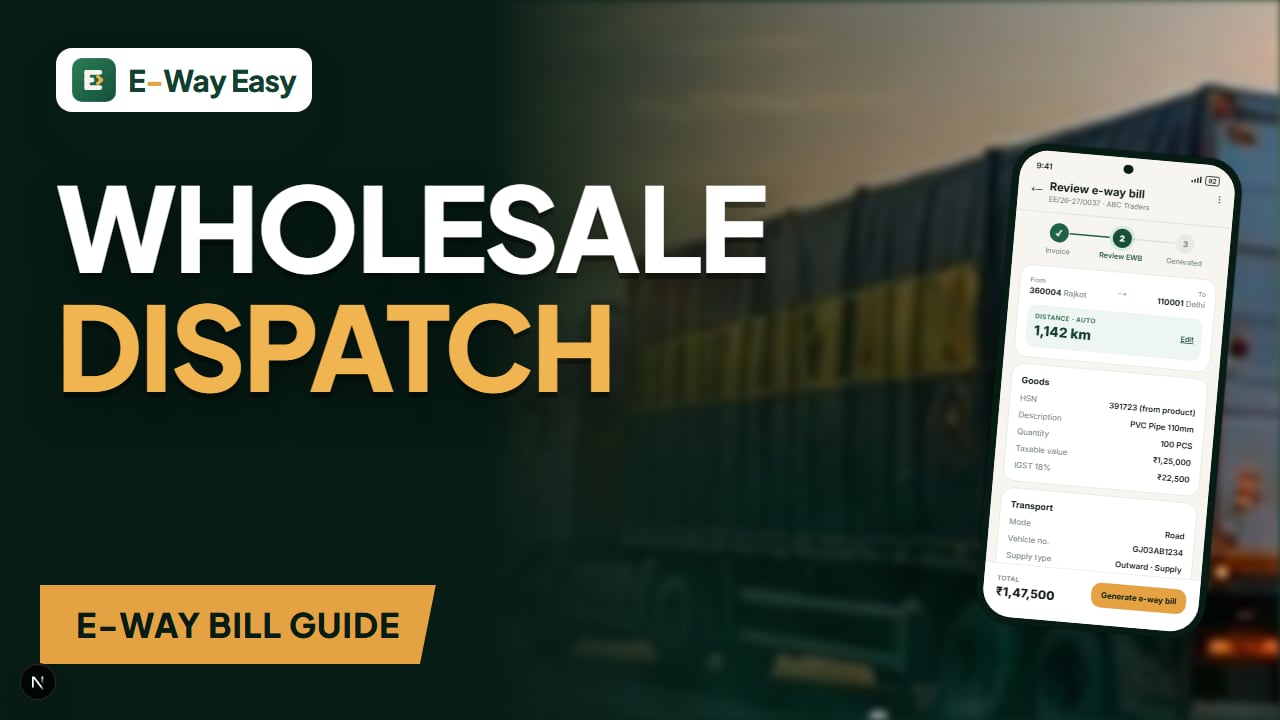
Table of contents
- The basic rule, briefly
- Situation 1: Many invoices, one vehicle
- Validity on multi-drop routes
- Situation 2: Godown-to-godown and godown-to-shop transfers
- Situation 3: Bill to one party, ship to another
- Situation 4: Returns from retailers
- Situation 5: Vehicle breakdown or change mid-route
- Example (illustrative)
- Common mistakes distributors make
- How to make this routine
- Official sources
Quick answer: Each invoice is generally assessed on its own against the ₹50,000 threshold, so generate an e-way bill for every qualifying invoice with the same vehicle in Part B. A consolidated e-way bill (EWB-02) can then group them for the trip. Godown transfers can also need one, against a delivery challan.
Wholesalers and distributors face a different e-way bill problem from manufacturers. A factory usually sends one large consignment to one buyer. A distributor sends one vehicle out with ten or fifteen invoices, some above the threshold and some below, to retailers spread across a route. Add godown transfers, returns from retailers and goods that are billed to one party and delivered to another, and the paperwork gets messy fast.
This guide covers the situations distributors run into most often and how to handle each one cleanly.
The basic rule, briefly
Under Section 68 of the CGST Act and Rule 138 of the CGST Rules, an e-way bill is generally required before goods move when the consignment value exceeds ₹50,000. Consignment value means the value declared in the invoice, bill of supply or delivery challan, including GST, but excluding the value of exempt supplies in the same document.
For intra-state movement, some states have notified different thresholds or exemptions. Check your state's notification on its commercial tax website or the official e-way bill portal. For more on this, see the ₹50,000 threshold and its exceptions.
Situation 1: Many invoices, one vehicle
This is the everyday distributor scenario. The practical approach:
- Identify which invoices cross the threshold. Each invoice (consignment) is generally assessed on its own value.
- Generate an e-way bill for each qualifying invoice. Part A for each one comes from the invoice. Part B carries the same vehicle number.
- Consider a consolidated e-way bill (EWB-02). The transporter, or you if you run your own vehicle, can group the individual e-way bills into one consolidated document for the trip. The driver then carries one consolidated reference instead of a stack.
- Carry the invoices for all goods, including those below the threshold. An officer can still ask for documents for every consignment on the vehicle.
Note: Do not split one supply into several invoices just to keep each below the limit. That defeats the purpose of the rule and can be questioned during inspection.
Validity on multi-drop routes
Validity depends on distance: one day for every 200 km or part of it for normal cargo, with the first day ending at midnight of the day after generation. Each e-way bill has its own distance, based on its own PIN-to-PIN route. On a long multi-drop route, the last drop's e-way bill will need the longest validity, so enter its actual distance correctly. See how distance affects e-way bill validity.
Situation 2: Godown-to-godown and godown-to-shop transfers
Distributors often move stock between their own places of business.
| Transfer type | Typical document | Notes |
|---|---|---|
| Same GSTIN, same state (e.g. godown to shop) | Delivery challan | Not a supply; e-way bill still needed if value crosses the threshold applicable in your state |
| Different GSTINs of the same business, different states | Tax invoice | Treated as a supply between distinct persons; IGST applies; e-way bill needed above ₹50,000 |
For the same-GSTIN case, the reason for transport on the portal is usually "own use" or a similar option; for the inter-state case, it is a supply. Value the delivery challan properly — an understated value can attract questions.
Situation 3: Bill to one party, ship to another
A common distributor arrangement: you bill a retailer in one town, but the goods go directly from your supplier's warehouse, or you bill a head office and deliver to its branch. The e-way bill portal provides transaction-type options for such "bill-to / ship-to" and "bill-from / dispatch-from" cases. The key is that Part A reflects the actual place of delivery (the ship-to PIN), because that is what determines the route and distance. Read E-way bill rules for returns and special transactions for more on these arrangements.
Situation 4: Returns from retailers
When a retailer sends back damaged or unsold stock, goods are moving again and the threshold applies to that movement. Who generates the e-way bill depends on who causes the movement — often the retailer (if registered) or the transporter. Distributors should agree in advance with retailers how returns will be documented, so goods do not get stuck on the road.
Situation 5: Vehicle breakdown or change mid-route
If the vehicle breaks down or the load is transferred to another vehicle, update Part B with the new vehicle number before the goods move further. Part B can be updated any number of times during validity. If you used a consolidated e-way bill, it can be updated for the new vehicle too. See how to update vehicle details in an e-way bill.
Example (illustrative)
A Surat textile distributor (GSTIN 24ABCDE1234F1Z5) loads a tempo with goods for six retailers in Bharuch and Vadodara:
| Retailer | Invoice value incl. GST | E-way bill? |
|---|---|---|
| A | ₹18,500 | Generally not required |
| B | ₹72,000 | Required |
| C | ₹41,000 | Generally not required |
| D | ₹1,15,000 | Required |
| E | ₹56,300 | Required |
| F | ₹9,800 | Generally not required |
The distributor:
- Generates three e-way bills (B, D, E), each with its own delivery PIN and distance.
- Fills Part B with the tempo number on all three.
- Generates a consolidated e-way bill for the trip, since the distributor runs its own vehicle.
- Hands the driver all six invoices plus the consolidated e-way bill reference.
Midway, the tempo develops a fault and goods are shifted to a second vehicle. The distributor updates the vehicle number on the consolidated e-way bill before the new vehicle leaves.
Common mistakes distributors make
- Assuming the vehicle total, not the invoice value, decides everything. The threshold is generally per consignment. Check your state's rules if you are unsure.
- Wrong delivery PIN. Using your own godown PIN or the billing PIN instead of the actual delivery PIN gives a wrong distance and validity.
- Forgetting the low-value invoices. They still need invoices on board.
- No e-way bill for stock transfers. Moving stock to your own shop is not a sale, but the e-way bill rule can still apply.
- Late Part B updates. If goods move in a vehicle that is not in Part B, that can be treated as moving without a valid e-way bill.
- Copying the buyer name from the order instead of the GST registration. Small spelling differences create confusion during verification.
How to make this routine
- Keep a saved list of retailers with verified GSTIN and delivery PIN.
- Sort the day's invoices by value before loading, so you know which need e-way bills.
- Assign one person to generate e-way bills and one to check vehicle numbers.
- Keep a simple daily log: invoice number, e-way bill number, vehicle number, drop status.
The free e-way bill eligibility checker can help staff quickly decide whether an invoice needs one, and the distance calculator helps estimate validity. For distributors who prepare invoices from a phone, the E-Way Easy app saves buyers and products and calculates PIN-based distance as part of its invoice flow.
Official sources
Thresholds, transaction types and portal options change from time to time. Confirm the current rules on the E-Way Bill System, its user documentation, and CBIC GST, and check your state's notification for intra-state movement.
Frequently asked questions
If one vehicle carries five invoices of ₹20,000 each, do I need e-way bills?
The threshold is generally assessed per consignment, which in practice means per invoice or document. Five separate invoices each below the threshold usually do not each need an e-way bill, but check your state's rules and avoid splitting a single supply into smaller invoices to stay under the limit.
What is a consolidated e-way bill?
It is Form GST EWB-02, generated by the transporter to cover several e-way bills moving in one vehicle. It does not replace the individual e-way bills; it groups them.
Do I need an e-way bill to move stock from my godown to my shop?
Movement of goods for reasons other than supply, such as own-use stock transfer, can still need an e-way bill if the value exceeds the threshold. Use a delivery challan as the document.
Sources and references
- E-Way Bill System (official portal)ewaybillgst.gov.in
- E-Way Bill user documentationdocs.ewaybillgst.gov.in
- CBIC GSTcbic-gst.gov.in
This article is general information, not tax or legal advice. GST and e-way bill requirements depend on the transaction, applicable notifications and state-specific provisions. Check the official portals before you rely on it.
Written by
Bhavesh AkabariBhavesh Akabari writes the E-Way Easy guides on e-way bills, GST invoicing and day-to-day compliance workflows for Indian manufacturers, wholesalers and traders. Every compliance article is checked against official GST and e-way bill sources and carries a "last verified" date.
Related articles
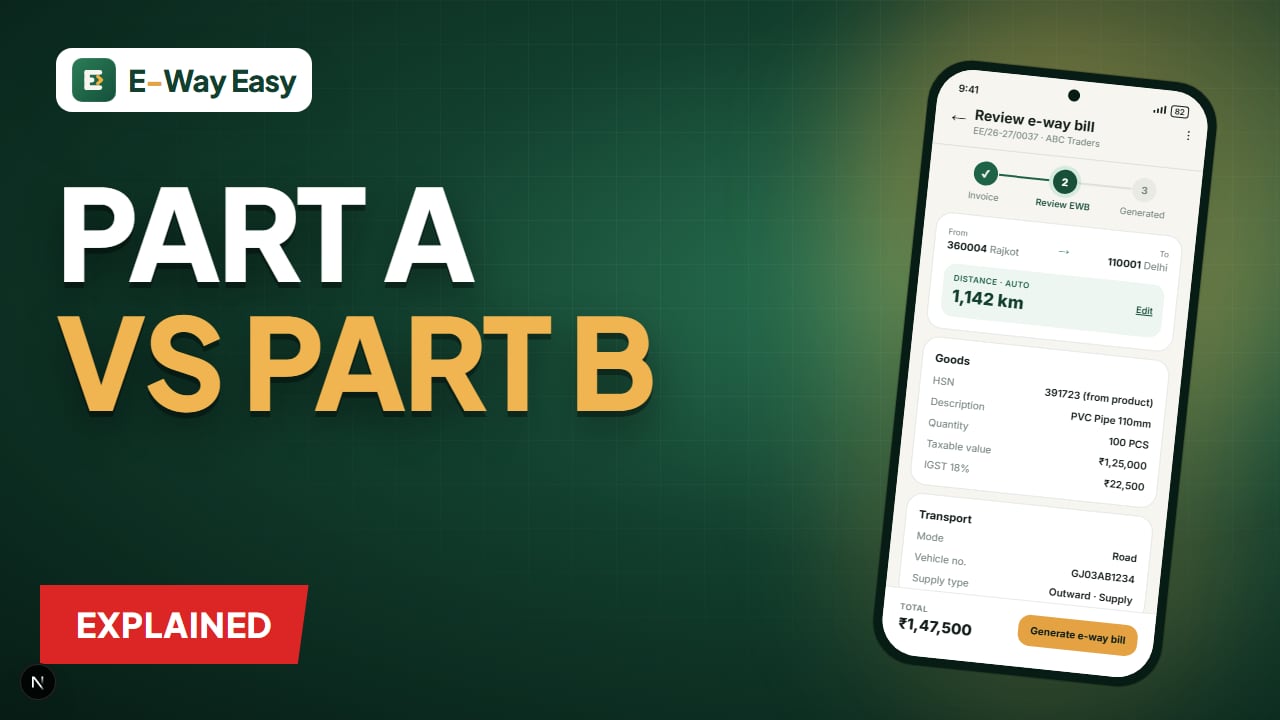
E-Way Bill Part A and Part B Explained
What goes into Part A and Part B of Form GST EWB-01, who fills each part, when Part B can be skipped, and how to correct mistakes in either part.
By Bhavesh Akabari · · 5 min read
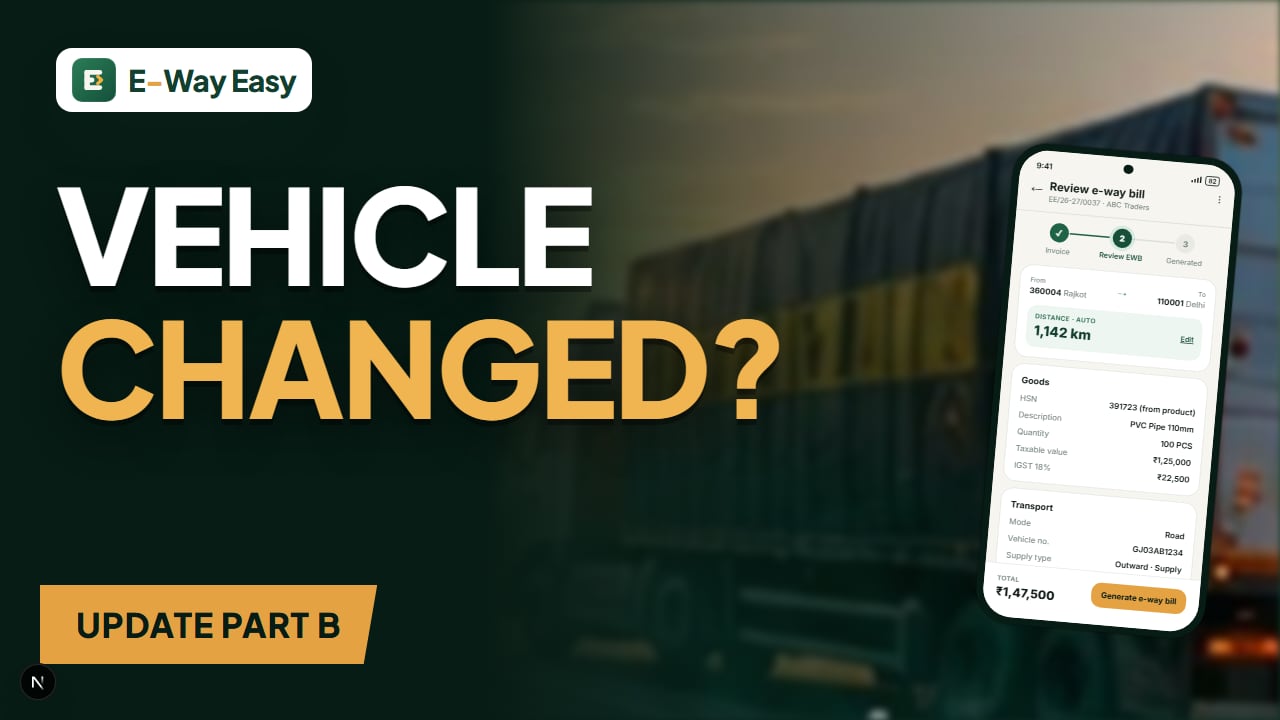
How to Update Vehicle Details in an E-Way Bill
Truck broke down or goods shifted to another vehicle? Here is how Part B of an e-way bill is updated, who can do it and what to check first.
By Bhavesh Akabari · · 6 min read
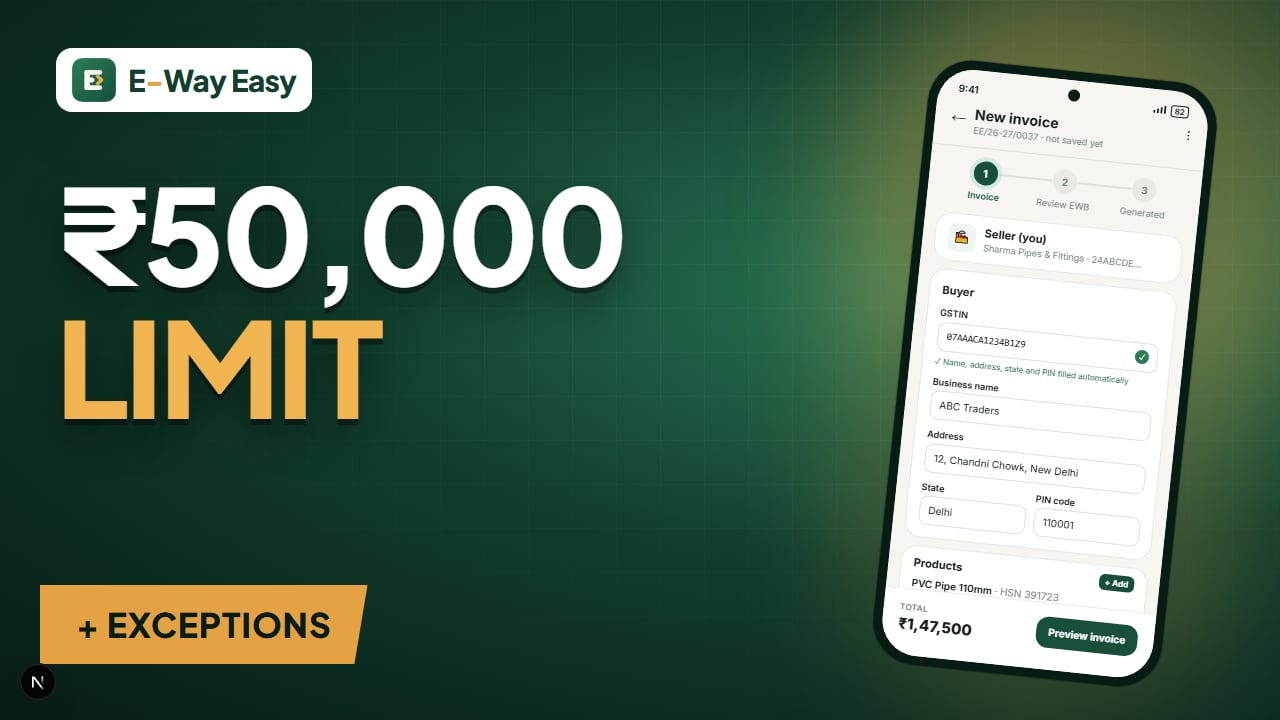
E-Way Bill Limit and the ₹50,000 Threshold: Rules and Exceptions
How the ₹50,000 e-way bill limit is calculated, what counts in consignment value, state thresholds, cases needing an e-way bill regardless of value, and exemptions.
By Bhavesh Akabari · · 5 min read