Invoice With GST or Without GST? Tax Invoice vs Bill of Supply
Who must charge GST on an invoice, who issues a bill of supply instead, and what changes on the document. A decision guide for small businesses.
Last verified against official sources: 6 Nov 2026
Drafted with AI assistance, edited and fact-checked by a person. How we write and check our guides
Table of contents
- The three situations
- 1. Registered seller, taxable supply: tax invoice with GST
- 2. Registered seller, no GST charged: bill of supply
- 3. Unregistered seller: plain bill, no GST
- The special case: tax invoice without GST
- What changes on the document
- Invoice-cum-bill of supply (Rule 46A)
- Example (illustrative): three sellers, three documents
- Decision flow: which document do I issue?
- Common mistakes
- Before you issue either document
- Quick action checklist
- Official sources
Quick answer: You charge GST only if you are GST-registered and the supply is taxable; that document is a tax invoice. If you are registered but the supply is exempt, or you are under the composition scheme, you issue a bill of supply with no GST. If you are not registered at all, you issue a plain bill and cannot charge GST.
"With GST or without GST?" sounds like a choice you make for each customer. It is not.
Whether GST appears on your document depends on two facts: are you registered, and is this supply taxable? Once those are clear, the document follows. This guide covers that decision; for the words bill, receipt and voucher, see invoice vs bill vs receipt.
The three situations
Every seller falls into one of three situations. A regular registered seller making a taxable supply issues a tax invoice with GST. A registered seller with an exempt supply, or a composition dealer, issues a bill of supply with no GST, while an unregistered seller issues a plain bill and must not show any GST at all.
1. Registered seller, taxable supply: tax invoice with GST
If you hold a GSTIN as a regular taxpayer and sell goods or services that attract GST, you must issue a tax invoice (Section 31 of the CGST Act, Rule 46) and charge GST. You cannot skip GST because the buyer asks for a "kachha bill" or is unregistered.
The buyer's status changes what you print, such as their GSTIN, not whether you charge tax. This applies equally if you registered voluntarily while below the threshold: once registered, you charge GST like any regular taxpayer.
2. Registered seller, no GST charged: bill of supply
A registered person issues a bill of supply instead of a tax invoice in two main cases (Section 31(3)(c) and Rule 49):
- Exempt supplies. "Exempt" in GST covers nil-rated, wholly exempt and non-taxable supplies. No tax is charged, so a tax invoice is the wrong document.
- Composition dealers. A composition business pays tax at a fixed rate on turnover from its own pocket and cannot collect GST from customers. Every sale goes on a bill of supply headed "composition taxable person, not eligible to collect tax on supplies".
Composition dealers in goods should also note that the scheme does not allow inter-state outward supplies of goods. If you start selling to other states, check your eligibility before you invoice.
3. Unregistered seller: plain bill, no GST
If you are below the registration threshold and have not registered voluntarily, you are outside the GST invoicing system. Still give the customer a bill or cash memo showing what was sold and the price.
That bill must not show GST or a GSTIN. Rule 49 is written for registered persons, so for an unregistered seller a simple, clear bill is the practical norm.
The special case: tax invoice without GST
Some registered suppliers issue a tax invoice that shows no GST and is still correct. This happens with zero-rated supplies, meaning exports and supplies to SEZ units or developers, made under bond or a letter of undertaking (LUT). No IGST is charged, but the document remains a tax invoice, not a bill of supply.
The invoice must carry an endorsement that the supply is made under bond or LUT without payment of integrated tax. Do not switch to a bill of supply format here; exporters and SEZ suppliers who do so end up with the wrong document type in their records.
What changes on the document
The main differences between a tax invoice, a bill of supply and a plain bill are the title, the tax columns and the declarations. A tax invoice shows GST rates and amounts; a bill of supply shows none and may need the composition declaration. A plain bill from an unregistered seller shows no GSTIN and no tax.
| Field | Tax invoice (with GST) | Bill of supply (registered, no GST) | Plain bill (unregistered) |
|---|---|---|---|
| Document title | "Tax Invoice" | "Bill of Supply" | "Bill", "Invoice" or "Cash Memo" |
| Your GSTIN | Required | Required | None (you have no GSTIN) |
| Buyer's GSTIN | If buyer is registered | If buyer is registered | Not needed |
| HSN / SAC code | Required as per your turnover rules | Required as per your turnover rules | Not required under GST |
| Taxable value | Shown | Value of supply shown | Price shown |
| CGST / SGST / IGST columns | Rate and amount shown | Not shown | Not shown |
| Place of supply | Required for inter-state supply | Not a tax-charging field | Not needed |
| Special declaration | Reverse charge statement where applicable; LUT endorsement for zero-rated supplies | Composition dealers: "composition taxable person, not eligible to collect tax on supplies" | None |
| Buyer can claim ITC? | Yes, if other conditions are met | No | No |
The field-by-field requirements, including HSN digit rules, are in the GST invoice rules guide.
Invoice-cum-bill of supply (Rule 46A)
An invoice-cum-bill of supply is a single document covering both taxable and exempt items sold together to an unregistered buyer. Without it, you would need a tax invoice for the taxable items and a separate bill of supply for the exempt ones. Rule 46A lets a registered person combine them in one document.
The taxable lines carry GST; the exempt lines show none. A general store selling packaged goods and an exempt item to a walk-in customer is the common case. If the buyer is registered, issue the two documents separately.
Example (illustrative): three sellers, three documents
The same purchase can produce three different documents, depending on who sells. Three Gujarat businesses each sell goods worth ₹20,000 to a Rajkot pipe manufacturer with sample GSTIN 24ABCDE1234F1Z5. Only one of them can charge GST, and only that seller's document lets the buyer claim input tax credit.
| Seller | Status | Document issued | GST on document | Total payable by buyer |
|---|---|---|---|---|
| A Surat textile trader | Regular registered, taxable goods at an illustrative 5% | Tax invoice | CGST ₹500 + SGST ₹500 | ₹21,000 |
| A Morbi hardware shop | Composition dealer | Bill of supply with composition declaration | None | ₹20,000 |
| A small Jamnagar workshop | Not registered | Plain bill | None | ₹20,000 |
The buyer claims ₹1,000 of input tax credit on the first document only. The composition dealer pays its own composition tax but cannot pass it on as GST, and the unregistered workshop pays no GST on this sale.
Rates are for illustration only. Confirm the current rate for your goods before invoicing. For working out the tax on a real invoice, see how to calculate GST on a sales invoice.
Decision flow: which document do I issue?
The right document follows from your registration status and the item's tax status, in that order. Answer the registration question first, then the composition question, then whether the item is exempt. The rules below cover almost every small-business case, including mixed baskets and exports made without paying IGST.
- If you are not registered under GST → then issue a plain bill. Do not charge GST or print a GSTIN.
- If you are registered under the composition scheme → then issue a bill of supply with the composition declaration and no tax.
- If you are a regular registered person and the item is exempt → then issue a bill of supply.
- If you are a regular registered person and the item is taxable → then issue a tax invoice with GST, whatever the buyer's status.
- If you export or supply to an SEZ under bond or LUT → then issue a tax invoice with the LUT endorsement and no IGST.
- If one sale has both taxable and exempt items and the buyer is unregistered → then you may issue an invoice-cum-bill of supply under Rule 46A.
- If you are unsure whether an item is exempt → then check the HSN and rate notification on the official portal first.
Common mistakes
Most "with or without GST" errors come from templates and customer pressure, not from the law being unclear. A default template prints tax columns for a composition dealer, or a registered seller drops GST because the buyer wants a lower price. Each one leaves the wrong tax on record.
- Charging GST without registration. An unregistered seller adding "GST 18%" collects tax it has no right to collect, and the buyer cannot claim it. If your sales have crossed the threshold, register first.
- Composition dealer showing tax. Often caused by a default template. Composition dealers must not collect tax on supplies.
- Registered seller dropping GST "on request". The tax on a taxable item is still due.
- Using a tax invoice for exempt items. Replace "GST 0%" on a tax invoice with a bill of supply.
- Missing declarations. A composition dealer's bill of supply without the required words is incomplete.
- Mixing series. Keep tax invoices and bills of supply in separate consecutive series, unique for the financial year.
Before you issue either document
Run three checks before any invoice or bill leaves your desk. Confirm the buyer's GSTIN if they are registered, confirm the tax amount if you are charging GST, and confirm whether the goods need an e-way bill. Each check takes a minute and prevents a correction later.
- If the buyer is registered, check their GSTIN. A wrong GSTIN on a tax invoice affects their credit.
- If you are charging GST, check the rate and amount against the current notification.
- If goods are moving and the consignment value crosses the e-way bill threshold, the e-way bill is generated against the tax invoice or bill of supply. See e-way bill vs sales invoice.
A template prints what you type. It cannot decide whether GST applies; that comes from your registration status and the item.
Quick action checklist
- Write down your registration status: regular, composition or unregistered.
- Mark each product you sell as taxable or exempt, using the current rate notification.
- Check that your template's title and declaration match your status.
- Separate the number series for tax invoices and bills of supply.
- If you export or supply to SEZs under LUT, add the endorsement to your invoice format.
Once you know which document you need, make it with the free invoice generator. Its With GST / Without GST switch adds or removes the tax columns, and you can add the title and any declaration yourself.
Official sources
Tax invoice requirements are in Section 31 of the CGST Act and Rule 46 of the CGST Rules, 2017; the bill of supply is in Rule 49 and the invoice-cum-bill of supply in Rule 46A. Composition scheme conditions are in Section 10 and the related rules. Read the current text on cbic-gst.gov.in and cbic.gov.in, and check registration guidance on the GST portal.
Frequently asked questions
Can I make an invoice without GST?
Yes, if you are not registered under GST, are a composition dealer, or are supplying exempt goods or services. Registered sellers then issue a bill of supply, and unregistered sellers issue a plain bill.
Can an unregistered business charge GST on its bill?
No. Only a registered person can collect GST. Showing GST on a bill without a valid registration is not allowed, and the buyer cannot claim that amount as input tax credit.
What is a bill of supply?
It is the document a registered person issues instead of a tax invoice when no GST is charged, mainly for exempt supplies and sales by composition dealers. Its contents are set out in Rule 49 of the CGST Rules, 2017.
What must a composition dealer write on a bill of supply?
The words "composition taxable person, not eligible to collect tax on supplies" at the top of the bill of supply. No GST amount may be shown on it.
Can the buyer claim input tax credit on a bill of supply?
No. A bill of supply carries no GST, so there is no tax for the buyer to claim. Input tax credit needs a valid tax invoice with GST shown on it.
Is an export invoice without IGST a bill of supply?
No. A zero-rated supply made under bond or LUT without paying IGST still goes on a tax invoice. The invoice carries an endorsement that the supply is made without payment of integrated tax.
Sources and references
- CBIC GST (Acts and Rules)cbic-gst.gov.in
- GST portalwww.gst.gov.in
- CBICwww.cbic.gov.in
This article is general information, not tax or legal advice. GST and e-way bill requirements depend on the transaction, applicable notifications and state-specific provisions. Check the official portals before you rely on it.
Written by
Bhavesh AkabariBhavesh Akabari writes and edits the E-Way Easy guides on e-way bills, GST invoicing and day-to-day compliance workflows for Indian manufacturers, wholesalers and traders. Drafts are prepared with AI assistance; he edits each one and checks the facts against official GST and e-way bill sources, and every compliance article carries a "last verified" date.
How we create contentRelated articles
Invoice vs Bill vs Receipt: What's the Difference in India?
Invoice, bill, receipt, cash memo, receipt voucher: what each word means in daily business and under GST, and which one your buyer needs for credit.
By Bhavesh Akabari · · 8 min read
How to Calculate GST on a Sales Invoice
A worked, line-by-line method for calculating GST on a sales invoice — with discounts, mixed rates, CGST/SGST vs IGST and rounding.
By Bhavesh Akabari · · 8 min read
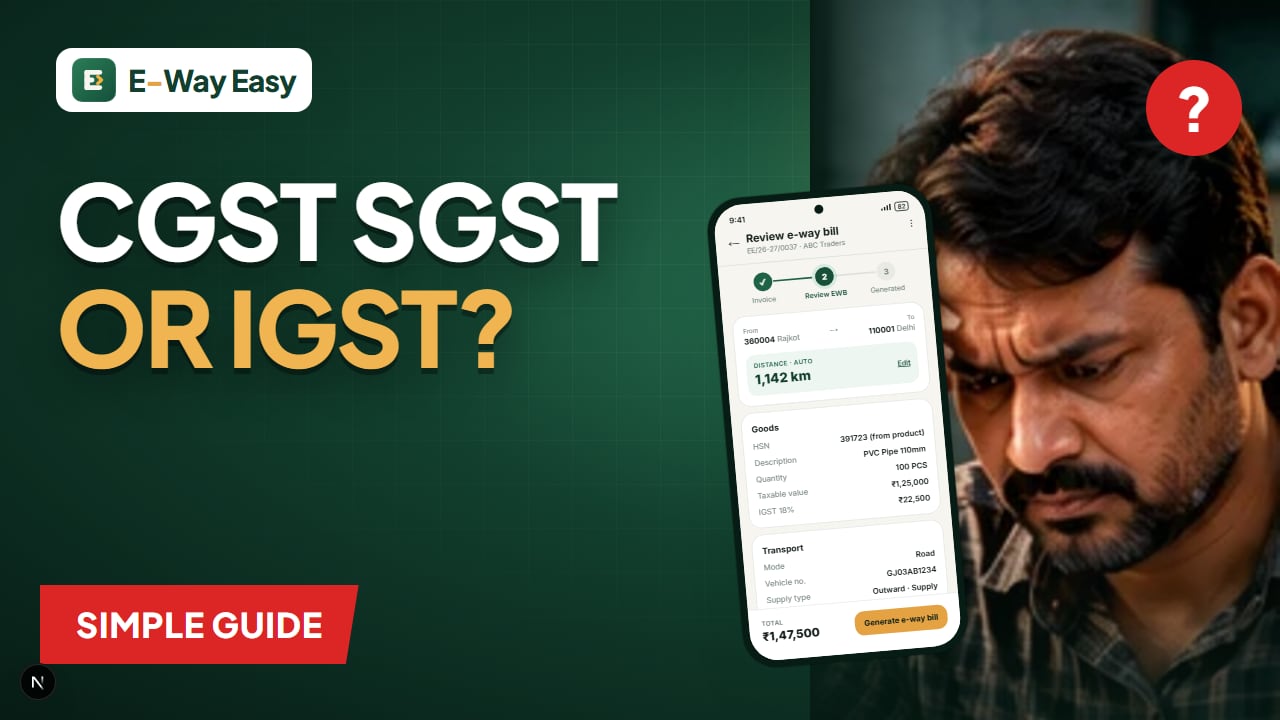
CGST vs. SGST vs. IGST Explained
Which GST applies to your sale — CGST plus SGST, or IGST? A plain-English guide to place of supply, UTGST, credit use and costly mix-ups.
By Bhavesh Akabari · · 7 min read