Process chain across units
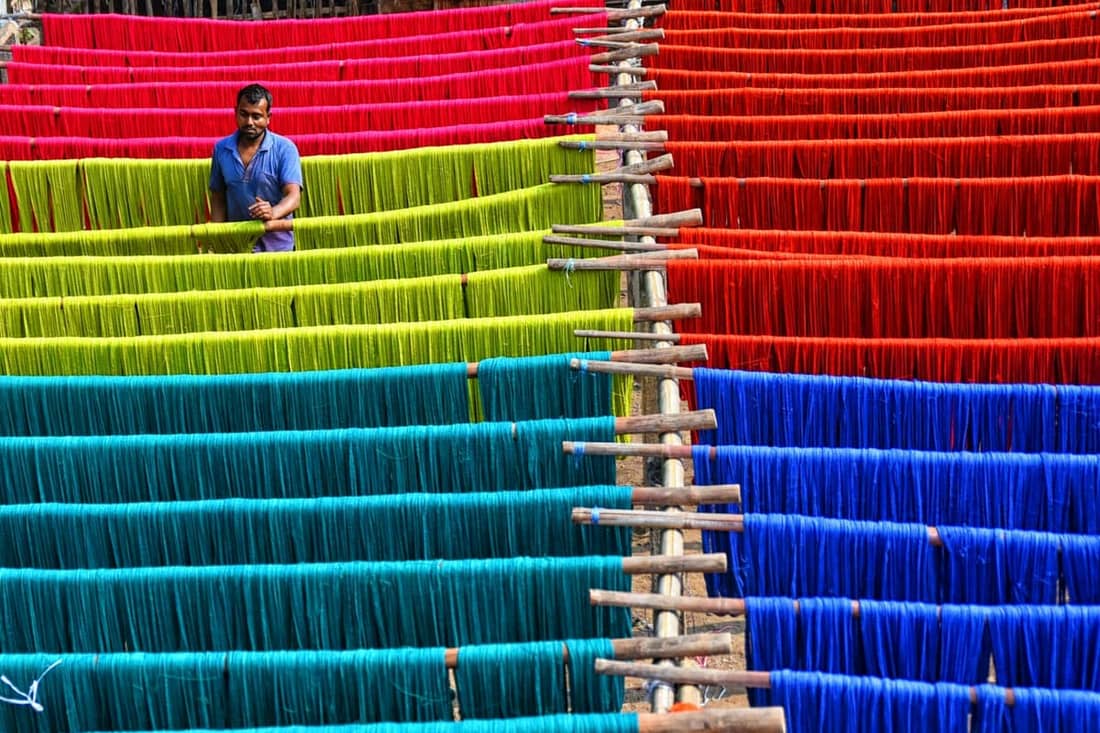
Grey fabric moves to a processor for dyeing or printing, then to an embroidery or stitching unit, then back to the principal or straight to a buyer.
Industry · Textile, fabric and apparel
Fabric rarely goes straight from loom to buyer. It moves to dyers, printers, embroiderers and stitching units and back again, often across state lines. Each of those trips has its own e-way bill position.
Quick answer: When a textile principal sends fabric or garments to a job worker in another state for dyeing, printing, stitching or embroidery, an e-way bill is required irrespective of value. Job work within the same state needs an e-way bill only if the value exceeds the limit (check your state’s intra-state limit). Job work goods move on a delivery challan, not a tax invoice. Sales of fabric and garments to traders follow the normal ₹50,000 per-consignment rule.
 Textile & Apparel
Documents for every dispatch
Sales invoice with GST
GST-registered and selling taxable goods? Issue a tax invoice with GSTIN, HSN and CGST + SGST or IGST. Make one free.
Invoice without GST
Not registered, composition or exempt goods? A bill or bill of supply with no tax charged. Make a bill without GST.
E-way bill
Needed when the consignment value is over ₹50,000, and always for inter-state job work. See which textile & apparel movements need one.
How goods move
Grey fabric moves to a processor for dyeing or printing, then to an embroidery or stitching unit, then back to the principal or straight to a buyer.
Many textile clusters depend on processors and job workers in neighbouring states, which brings in the inter-state job work rule.
Garments and fabric often reach the market through commission agents, stockists and wholesale traders in textile markets.
Sample lots, small reorders and returns from processors mean frequent dispatches, some below the value limit and some above.
E-way bill position
The ₹50,000 limit is checked per consignment, including GST. Some movements need an e-way bill whatever the value. See the e-way bill rules for the full picture.
| Movement | Document | E-way bill |
|---|---|---|
| Fabric sent to a job worker (dyeing, printing) in another state | Delivery challan (Job Work) | Required irrespective of value |
| Fabric sent to a job worker in the same state | Delivery challan (Job Work) | Required if the value exceeds the limit (check your state’s intra-state limit) |
| Processed goods returned from the job worker to the principal | Delivery challan | Generally required if the value exceeds the limit; check the inter-state position with your adviser |
| Finished goods sent directly from the job worker to the buyer | Principal’s tax invoice (as permitted under the job work rules) | Required if the consignment value exceeds ₹50,000 |
| Fabric or garments sold to a trader or wholesaler | Tax invoice | Required if the consignment value exceeds ₹50,000 |
| Specified handicraft textiles moved inter-state by a person exempt from registration | Delivery challan or the document the rules allow | Required irrespective of value |
Watch out
A ₹20,000 lot of fabric going to a dyer across the state border still needs an e-way bill. The value limit does not apply to inter-state job work by a principal.
Goods sent for processing are not sold, so they move on a delivery challan. A tax invoice for a job work trip creates GST confusion later.
Challans for goods coming back from processors are often missing, which makes it hard to match what went out with what came back.
Fabric, yarn and garments sit under different HSN codes and rates. A wrong HSN on the e-way bill does not match the document carried.
E-Way Easy app
Create the GST invoice and its e-way bill in one flow, with saved buyers and products carrying HSN and rates.
Enter the buyer’s GSTIN and the name, address, state and PIN fill automatically; use Bill To / Ship To when goods go to a godown.
Set Dispatch From when finished goods leave from a job worker’s unit rather than your own.
The app does not create delivery challans. Use the free delivery challan generator on this website at /tools/delivery-challan-generator for job work trips.
Update Part B with the new vehicle number from your phone within the e-way bill’s validity.
Before the truck leaves
Free tools
Prepare job work challans for fabric going to dyers, printers and stitching units.
Open the Delivery Challan GeneratorFind the right HSN for yarn, fabric and garments before filling the e-way bill.
Open the HSN Chapter LookupCheck whether a same-state job work lot or a garment sale needs an e-way bill.
Open the E-Way Bill Eligibility CheckerRead next
FAQ
If a principal sends goods to a job worker in another state, yes, the e-way bill is required irrespective of value. Within the same state, it is needed only if the value exceeds the limit.
Generally the principal generates it. A registered job worker can also generate it, for example when sending goods back; check the details in Rule 138.
A delivery challan with the Job Work sub-type. A tax invoice is not used because the goods are not being sold.
Yes, if the consignment value, meaning taxable value plus GST, exceeds ₹50,000. Some states have a different limit for intra-state movement, so check your state’s notification.
No. The app creates GST invoices and e-way bills. For job work challans, use the free delivery challan generator on this website.
General information, not tax advice. Check current rules on the official e-way bill portal. E-Way Easy is not affiliated with GSTN or NIC.